Mosasaur Tooth in sm case
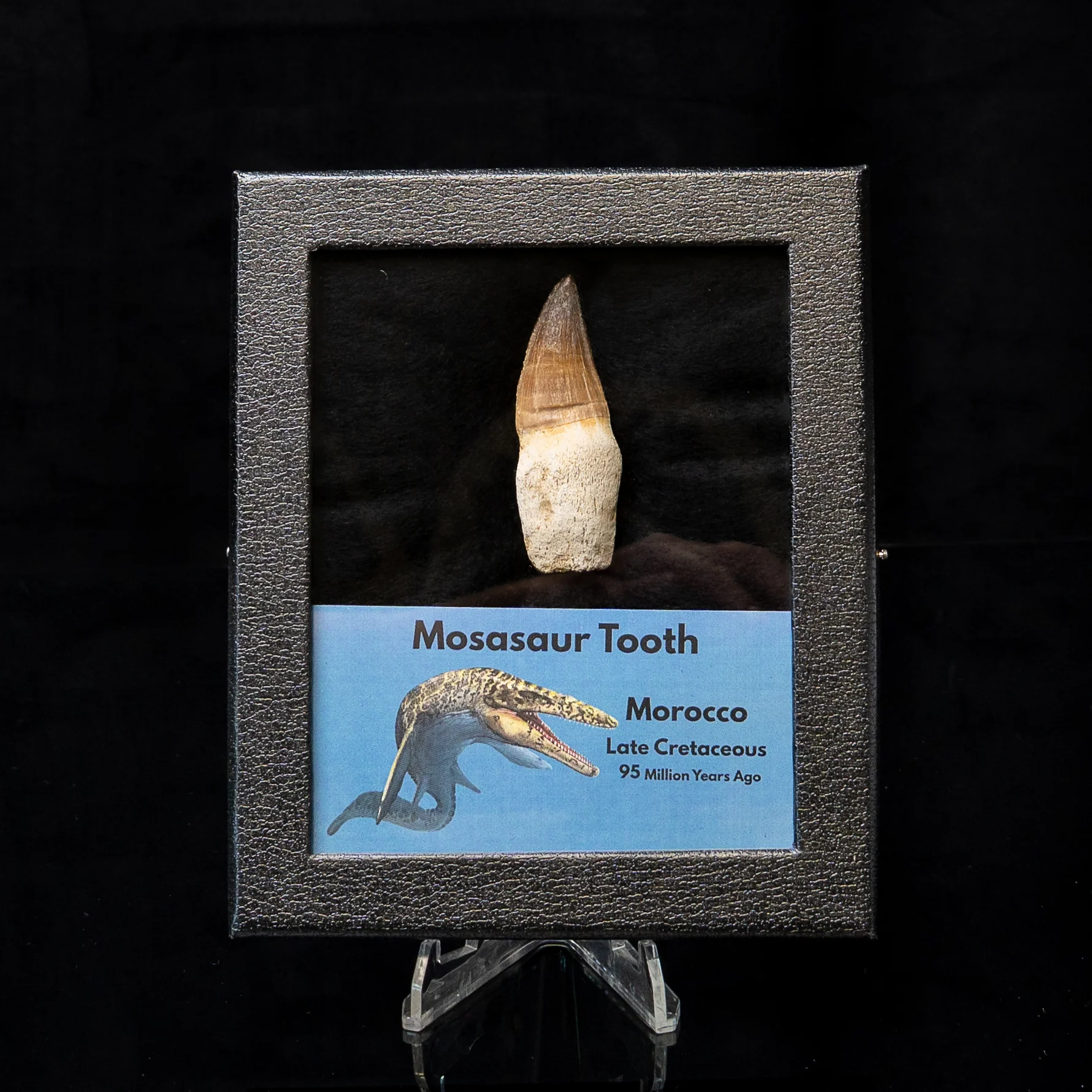
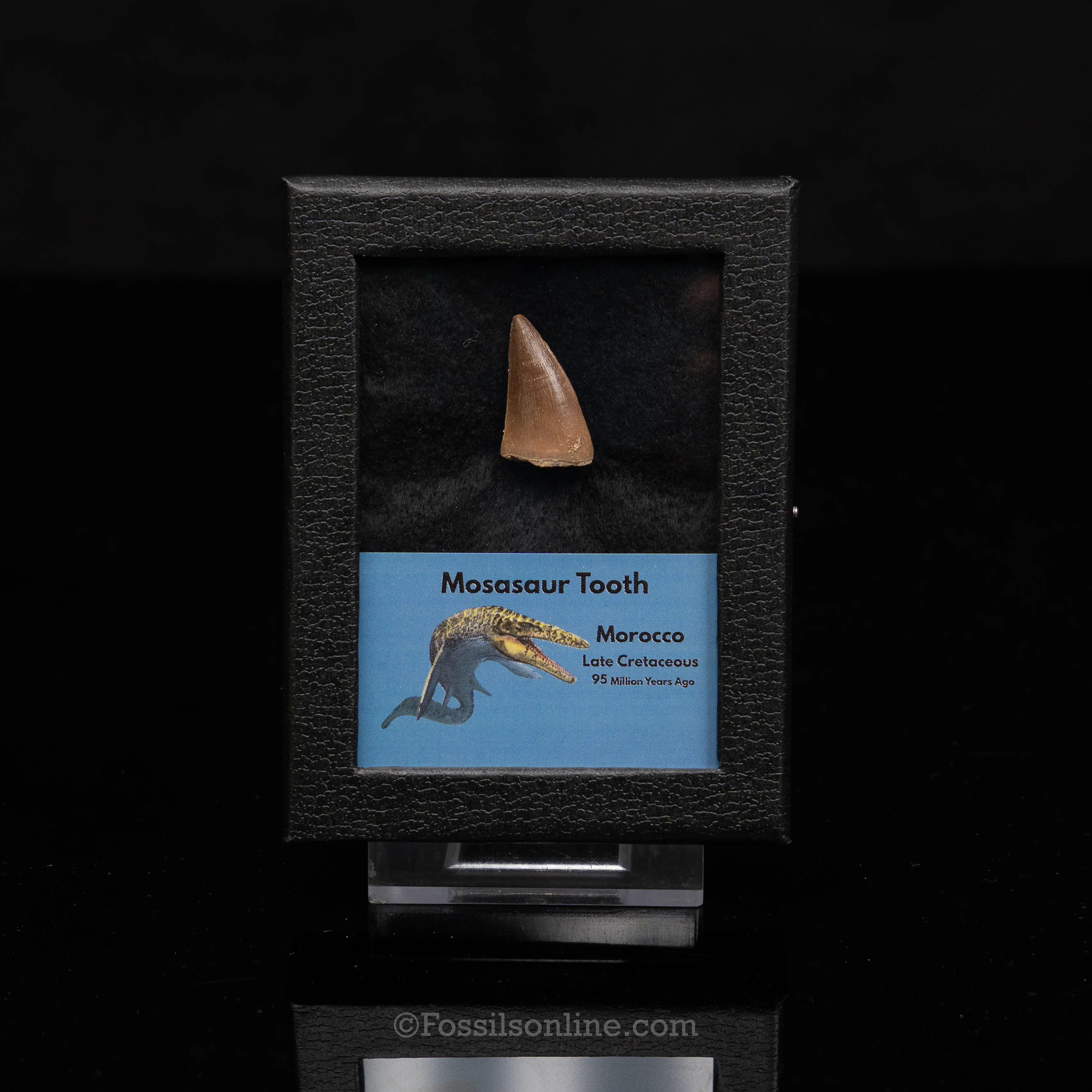
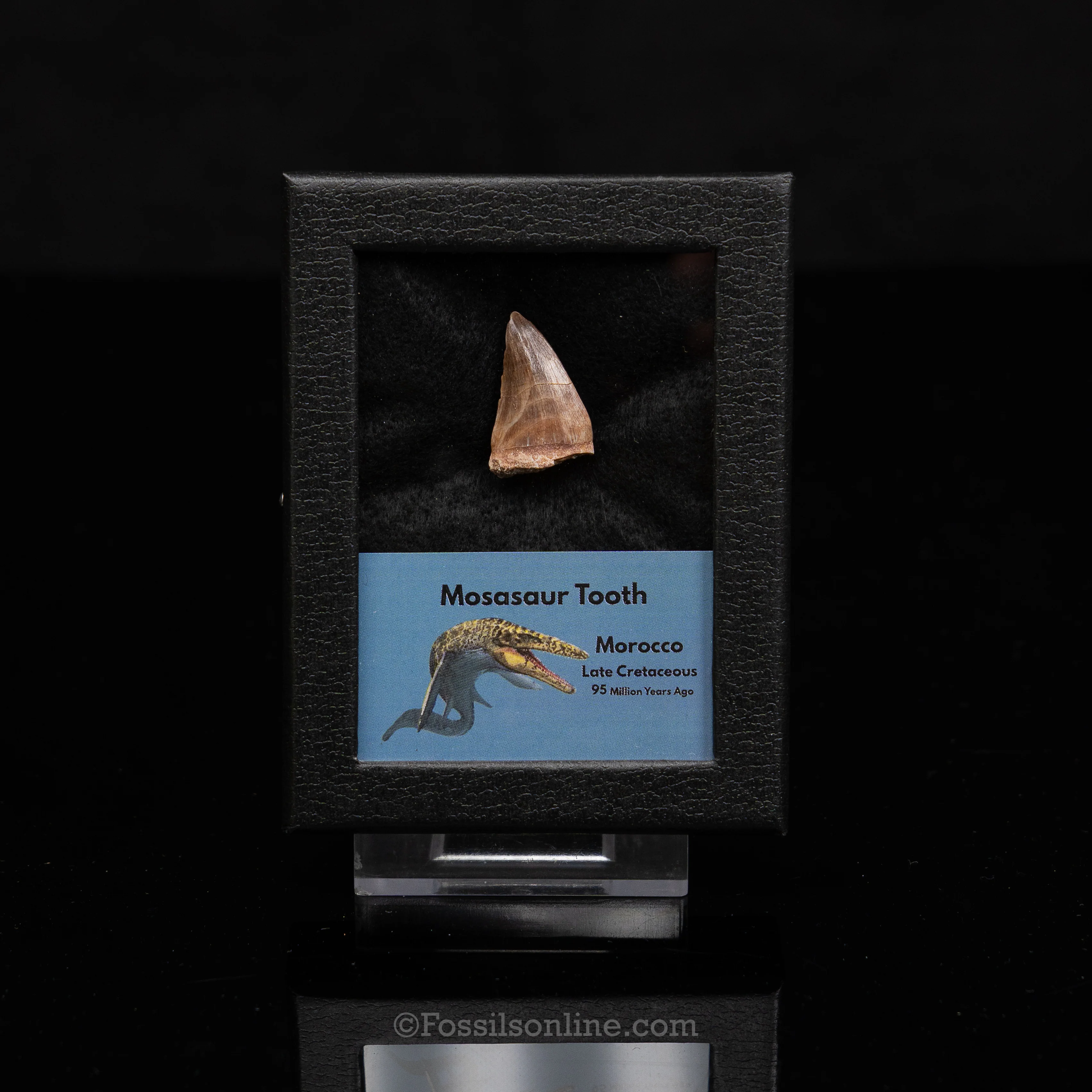
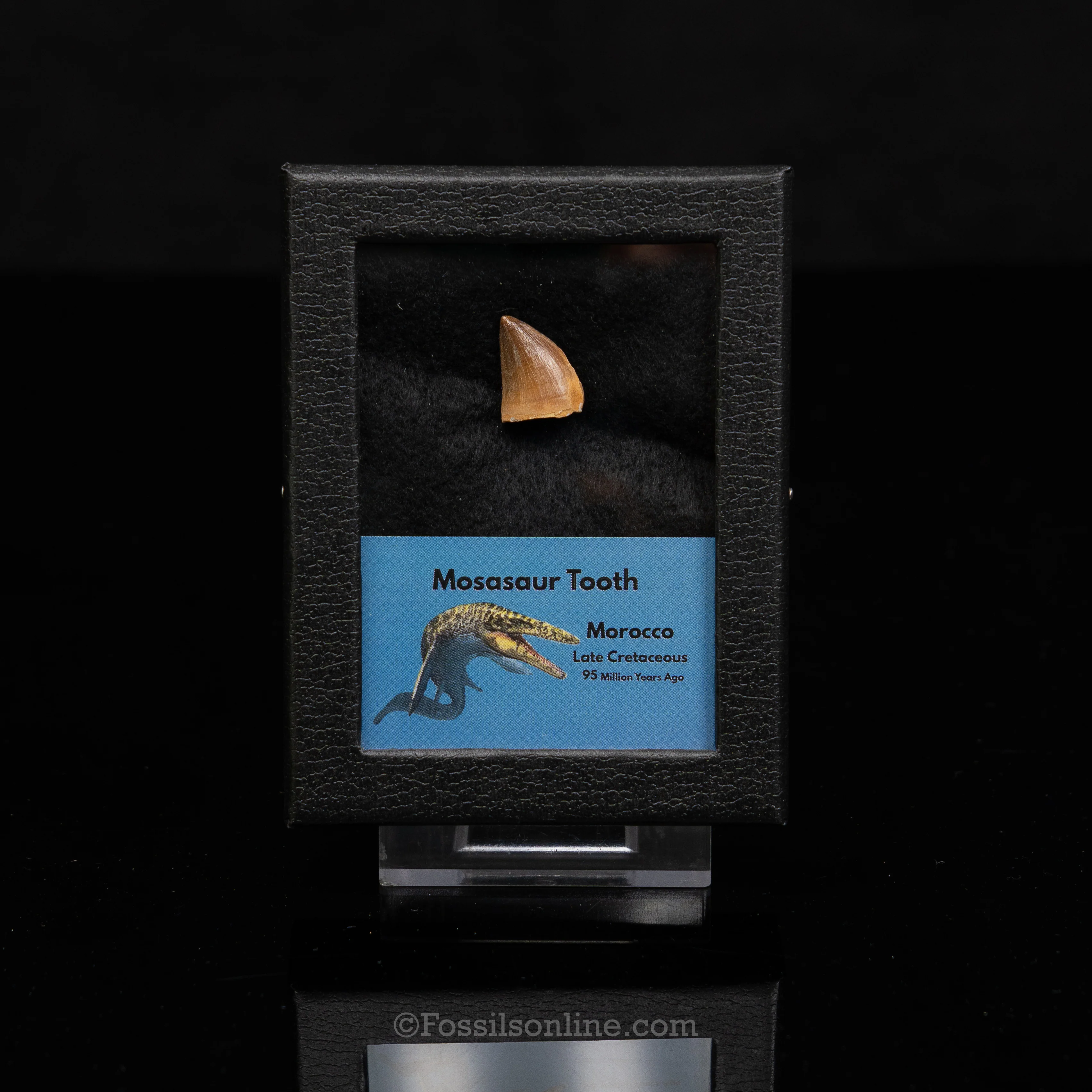
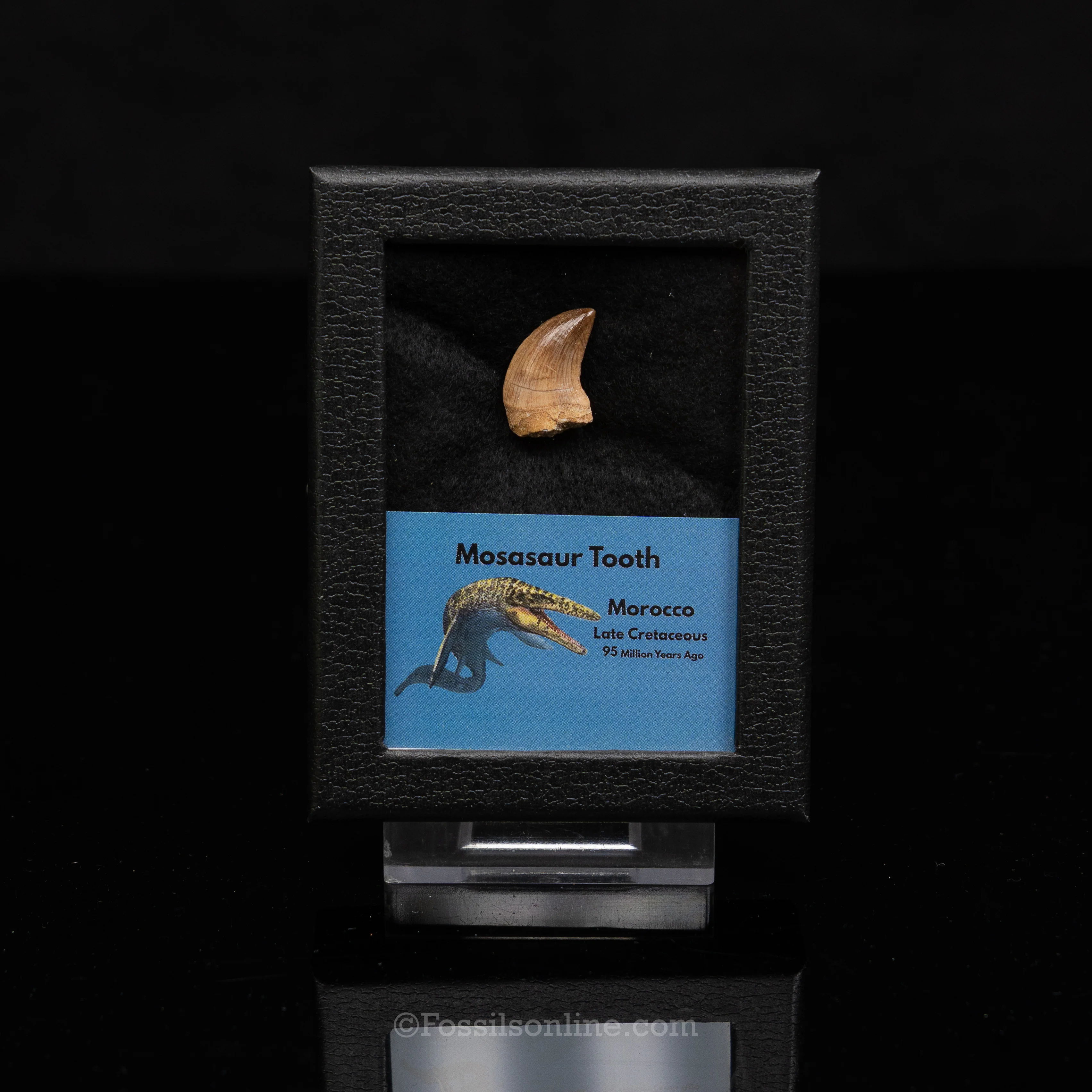
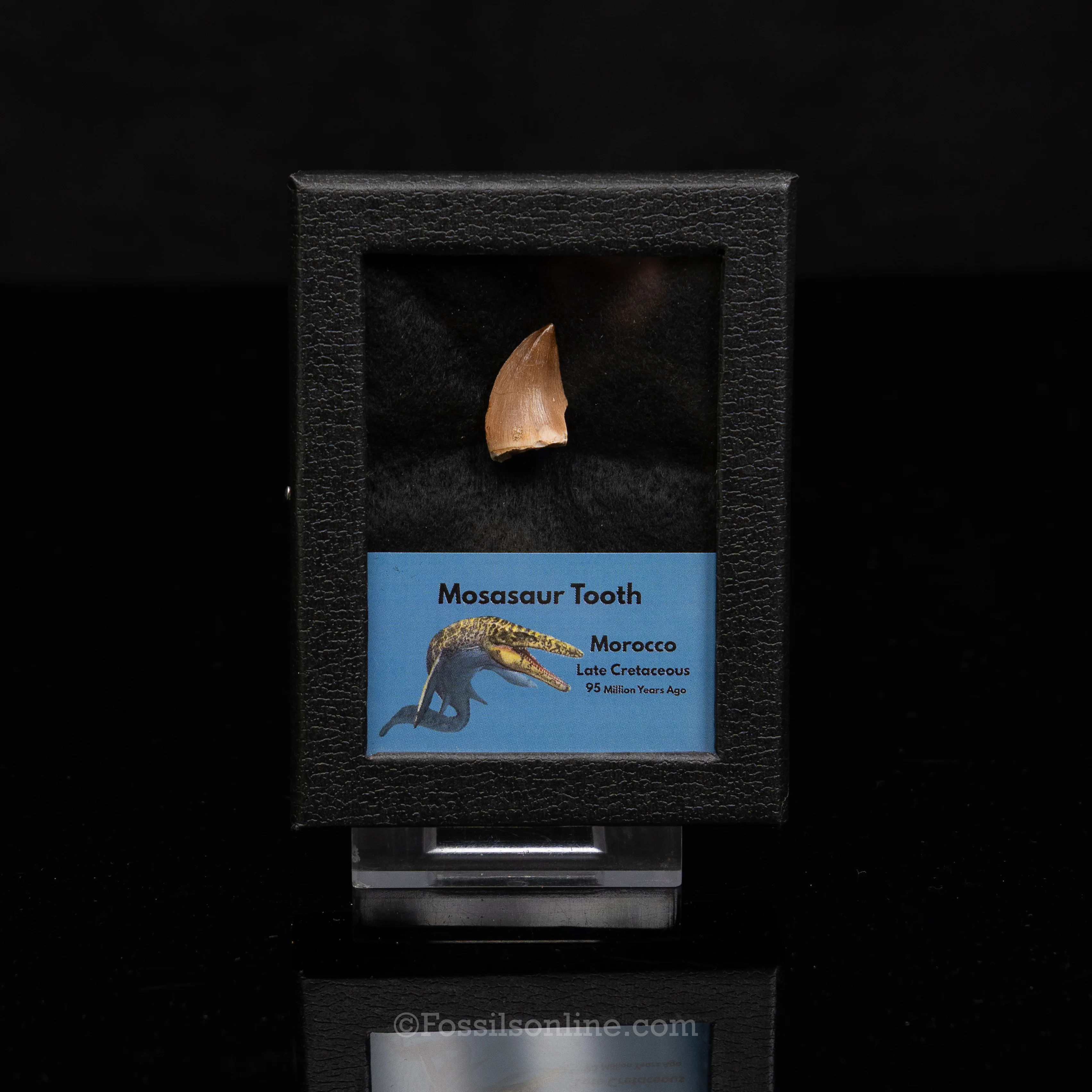
A good-quality, Mosasaur tooth presented in a 3” x 4” display box. The condition of these Mosasaur teeth varies—some include minor repair, while others are entirely natural
Mosasaur is one of the most famous marine reptiles ever discovered, but despite how often people lump it in with dinosaurs, it was not a dinosaur at all. Mosasaurs were large aquatic reptiles, more closely related to lizards and snakes than to dinosaurs like Tyrannosaurus or Spinosaurus. They lived during the Late Cretaceous and became some of the top predators in the world’s seas before going extinct at the end of the age of dinosaurs.
At the same time dinosaurs ruled the land, mosasaurs ruled the water. That difference matters. Dinosaurs were primarily land animals with an upright stance and limbs built for life on land, while mosasaurs were fully adapted for marine life, with paddle-like limbs, powerful tails, and streamlined bodies built for swimming. They were not “sea dinosaurs.” They were marine lizards that evolved into some of the most formidable predators of the Cretaceous oceans.
One of the most important things about mosasaurs is their discovery. The earliest famous mosasaur fossils were found in the late 1700s near Maastricht in the Netherlands, in limestone quarries near the Meuse River. That is where the name Mosasaurus comes from, meaning “Meuse lizard.” These fossils became historically important because they helped scientists realize that giant reptiles unlike anything living today had once existed. In other words, mosasaurs played a major role in the early understanding of extinction and prehistoric life.
Unlike a lot of dinosaur groups that people picture as all roughly similar, mosasaurs were surprisingly diverse. “Mosasaur” does not mean one single animal. It is a whole group of marine reptiles that included sleek fish-hunters, giant apex predators, and forms with specialized crushing teeth. Well-known genera include Mosasaurus, Tylosaurus, Platecarpus, Clidastes, Prognathodon, and Globidens. Some had long, sharp teeth for catching fish and squid, while others had blunt, rounded teeth suited for crushing shellfish and armored prey.
They lived in warm seas around the world, including Europe, North America, and North Africa. In North America, mosasaurs thrived in the Western Interior Seaway, a vast inland sea that once split the continent in two. Other important fossils come from places like Morocco and the Netherlands. These ancient marine environments were full of fish, ammonites, turtles, sharks, seabirds, and other marine reptiles, giving mosasaurs a rich and dangerous world to dominate.
Mosasaur jaws are one of the most fascinating things about them. Their mouths were lined with sharp, backward-curving teeth designed to grab and hold slippery prey. But what makes them even more impressive is that they also had an extra set of teeth on the roof of the mouth called pterygoid teeth. People sometimes call these “throat teeth,” though they were actually located on the palate, not deep in the throat. These extra teeth helped grip struggling prey and move it backward into the mouth for swallowing. It gave mosasaurs a feeding system that was especially effective in the water, where prey could be hard to control.
That jaw setup is one reason mosasaurs were such efficient hunters. Depending on the species, they could feed on fish, squid, ammonites, turtles, seabirds, and even other marine reptiles. Some were generalists, while others were more specialized. Globidens, for example, had round, crushing teeth built for hard-shelled prey, while larger predators like Mosasaurus and Tylosaurus were armed with sharp teeth for seizing larger animals. Their skulls and jaws show that mosasaurs were not one-note predators. They had a wide variety of feeding styles, which helps explain how so many kinds could live in the same seas.
In terms of lifestyle, mosasaurs were fully marine reptiles. They were air-breathers, but they spent their lives in the ocean, swimming with powerful side-to-side tail motion and steering with flippers. They did not live like crocodiles basking along shorelines, and they were far more specialized for open-water hunting than most people realize. Some researchers also think they gave birth to live young at sea rather than returning to land to lay eggs, which would make sense for animals so thoroughly adapted to marine life.
The most famous mosasaur in pop culture is easily Mosasaurus from the Jurassic World movies. For a lot of people, that was their first introduction to the group. The movie version is exaggerated, especially in scale and behavior, but it did help bring mosasaurs into the spotlight. In reality, they were already plenty impressive without Hollywood boosting them. They were giant marine reptiles, fast and deadly in the water, but they were not dinosaurs and they did not live during the Jurassic. They lived later, in the Late Cretaceous.
What makes mosasaurs so compelling is that they show the Age of Dinosaurs was not just about dinosaurs. While ceratopsians, hadrosaurs, and tyrannosaurs dominated the land, the seas were controlled by a completely different cast of reptiles. Mosasaurs were part of that marine story. They were diverse, highly specialized, and evolutionarily successful, filling many of the top predator roles in the world’s oceans right up until the end-Cretaceous extinction.
mosasaurs were real sea monsters, they changed how people thought about extinction, ancient oceans, and reptile evolution. Their jaws, palate teeth, swimming adaptations, and wide range of forms make them among the most remarkable marine reptiles ever to live.
Product Information
Product Information
Shipping & Returns
Shipping & Returns
Mosasaur Tooth in sm case
Mosasaur Tooth in sm case
A good-quality, Mosasaur tooth presented in a 3” x 4” display box. The condition of these Mosasaur teeth varies—some include minor repair, while others are entirely natural
Mosasaur is one of the most famous marine reptiles ever discovered, but despite how often people lump it in with dinosaurs, it was not a dinosaur at all. Mosasaurs were large aquatic reptiles, more closely related to lizards and snakes than to dinosaurs like Tyrannosaurus or Spinosaurus. They lived during the Late Cretaceous and became some of the top predators in the world’s seas before going extinct at the end of the age of dinosaurs.
At the same time dinosaurs ruled the land, mosasaurs ruled the water. That difference matters. Dinosaurs were primarily land animals with an upright stance and limbs built for life on land, while mosasaurs were fully adapted for marine life, with paddle-like limbs, powerful tails, and streamlined bodies built for swimming. They were not “sea dinosaurs.” They were marine lizards that evolved into some of the most formidable predators of the Cretaceous oceans.
One of the most important things about mosasaurs is their discovery. The earliest famous mosasaur fossils were found in the late 1700s near Maastricht in the Netherlands, in limestone quarries near the Meuse River. That is where the name Mosasaurus comes from, meaning “Meuse lizard.” These fossils became historically important because they helped scientists realize that giant reptiles unlike anything living today had once existed. In other words, mosasaurs played a major role in the early understanding of extinction and prehistoric life.
Unlike a lot of dinosaur groups that people picture as all roughly similar, mosasaurs were surprisingly diverse. “Mosasaur” does not mean one single animal. It is a whole group of marine reptiles that included sleek fish-hunters, giant apex predators, and forms with specialized crushing teeth. Well-known genera include Mosasaurus, Tylosaurus, Platecarpus, Clidastes, Prognathodon, and Globidens. Some had long, sharp teeth for catching fish and squid, while others had blunt, rounded teeth suited for crushing shellfish and armored prey.
They lived in warm seas around the world, including Europe, North America, and North Africa. In North America, mosasaurs thrived in the Western Interior Seaway, a vast inland sea that once split the continent in two. Other important fossils come from places like Morocco and the Netherlands. These ancient marine environments were full of fish, ammonites, turtles, sharks, seabirds, and other marine reptiles, giving mosasaurs a rich and dangerous world to dominate.
Mosasaur jaws are one of the most fascinating things about them. Their mouths were lined with sharp, backward-curving teeth designed to grab and hold slippery prey. But what makes them even more impressive is that they also had an extra set of teeth on the roof of the mouth called pterygoid teeth. People sometimes call these “throat teeth,” though they were actually located on the palate, not deep in the throat. These extra teeth helped grip struggling prey and move it backward into the mouth for swallowing. It gave mosasaurs a feeding system that was especially effective in the water, where prey could be hard to control.
That jaw setup is one reason mosasaurs were such efficient hunters. Depending on the species, they could feed on fish, squid, ammonites, turtles, seabirds, and even other marine reptiles. Some were generalists, while others were more specialized. Globidens, for example, had round, crushing teeth built for hard-shelled prey, while larger predators like Mosasaurus and Tylosaurus were armed with sharp teeth for seizing larger animals. Their skulls and jaws show that mosasaurs were not one-note predators. They had a wide variety of feeding styles, which helps explain how so many kinds could live in the same seas.
In terms of lifestyle, mosasaurs were fully marine reptiles. They were air-breathers, but they spent their lives in the ocean, swimming with powerful side-to-side tail motion and steering with flippers. They did not live like crocodiles basking along shorelines, and they were far more specialized for open-water hunting than most people realize. Some researchers also think they gave birth to live young at sea rather than returning to land to lay eggs, which would make sense for animals so thoroughly adapted to marine life.
The most famous mosasaur in pop culture is easily Mosasaurus from the Jurassic World movies. For a lot of people, that was their first introduction to the group. The movie version is exaggerated, especially in scale and behavior, but it did help bring mosasaurs into the spotlight. In reality, they were already plenty impressive without Hollywood boosting them. They were giant marine reptiles, fast and deadly in the water, but they were not dinosaurs and they did not live during the Jurassic. They lived later, in the Late Cretaceous.
What makes mosasaurs so compelling is that they show the Age of Dinosaurs was not just about dinosaurs. While ceratopsians, hadrosaurs, and tyrannosaurs dominated the land, the seas were controlled by a completely different cast of reptiles. Mosasaurs were part of that marine story. They were diverse, highly specialized, and evolutionarily successful, filling many of the top predator roles in the world’s oceans right up until the end-Cretaceous extinction.
mosasaurs were real sea monsters, they changed how people thought about extinction, ancient oceans, and reptile evolution. Their jaws, palate teeth, swimming adaptations, and wide range of forms make them among the most remarkable marine reptiles ever to live.
Original: $25.00
-65%$25.00
$8.75Product Information
Product Information
Shipping & Returns
Shipping & Returns
Description
A good-quality, Mosasaur tooth presented in a 3” x 4” display box. The condition of these Mosasaur teeth varies—some include minor repair, while others are entirely natural
Mosasaur is one of the most famous marine reptiles ever discovered, but despite how often people lump it in with dinosaurs, it was not a dinosaur at all. Mosasaurs were large aquatic reptiles, more closely related to lizards and snakes than to dinosaurs like Tyrannosaurus or Spinosaurus. They lived during the Late Cretaceous and became some of the top predators in the world’s seas before going extinct at the end of the age of dinosaurs.
At the same time dinosaurs ruled the land, mosasaurs ruled the water. That difference matters. Dinosaurs were primarily land animals with an upright stance and limbs built for life on land, while mosasaurs were fully adapted for marine life, with paddle-like limbs, powerful tails, and streamlined bodies built for swimming. They were not “sea dinosaurs.” They were marine lizards that evolved into some of the most formidable predators of the Cretaceous oceans.
One of the most important things about mosasaurs is their discovery. The earliest famous mosasaur fossils were found in the late 1700s near Maastricht in the Netherlands, in limestone quarries near the Meuse River. That is where the name Mosasaurus comes from, meaning “Meuse lizard.” These fossils became historically important because they helped scientists realize that giant reptiles unlike anything living today had once existed. In other words, mosasaurs played a major role in the early understanding of extinction and prehistoric life.
Unlike a lot of dinosaur groups that people picture as all roughly similar, mosasaurs were surprisingly diverse. “Mosasaur” does not mean one single animal. It is a whole group of marine reptiles that included sleek fish-hunters, giant apex predators, and forms with specialized crushing teeth. Well-known genera include Mosasaurus, Tylosaurus, Platecarpus, Clidastes, Prognathodon, and Globidens. Some had long, sharp teeth for catching fish and squid, while others had blunt, rounded teeth suited for crushing shellfish and armored prey.
They lived in warm seas around the world, including Europe, North America, and North Africa. In North America, mosasaurs thrived in the Western Interior Seaway, a vast inland sea that once split the continent in two. Other important fossils come from places like Morocco and the Netherlands. These ancient marine environments were full of fish, ammonites, turtles, sharks, seabirds, and other marine reptiles, giving mosasaurs a rich and dangerous world to dominate.
Mosasaur jaws are one of the most fascinating things about them. Their mouths were lined with sharp, backward-curving teeth designed to grab and hold slippery prey. But what makes them even more impressive is that they also had an extra set of teeth on the roof of the mouth called pterygoid teeth. People sometimes call these “throat teeth,” though they were actually located on the palate, not deep in the throat. These extra teeth helped grip struggling prey and move it backward into the mouth for swallowing. It gave mosasaurs a feeding system that was especially effective in the water, where prey could be hard to control.
That jaw setup is one reason mosasaurs were such efficient hunters. Depending on the species, they could feed on fish, squid, ammonites, turtles, seabirds, and even other marine reptiles. Some were generalists, while others were more specialized. Globidens, for example, had round, crushing teeth built for hard-shelled prey, while larger predators like Mosasaurus and Tylosaurus were armed with sharp teeth for seizing larger animals. Their skulls and jaws show that mosasaurs were not one-note predators. They had a wide variety of feeding styles, which helps explain how so many kinds could live in the same seas.
In terms of lifestyle, mosasaurs were fully marine reptiles. They were air-breathers, but they spent their lives in the ocean, swimming with powerful side-to-side tail motion and steering with flippers. They did not live like crocodiles basking along shorelines, and they were far more specialized for open-water hunting than most people realize. Some researchers also think they gave birth to live young at sea rather than returning to land to lay eggs, which would make sense for animals so thoroughly adapted to marine life.
The most famous mosasaur in pop culture is easily Mosasaurus from the Jurassic World movies. For a lot of people, that was their first introduction to the group. The movie version is exaggerated, especially in scale and behavior, but it did help bring mosasaurs into the spotlight. In reality, they were already plenty impressive without Hollywood boosting them. They were giant marine reptiles, fast and deadly in the water, but they were not dinosaurs and they did not live during the Jurassic. They lived later, in the Late Cretaceous.
What makes mosasaurs so compelling is that they show the Age of Dinosaurs was not just about dinosaurs. While ceratopsians, hadrosaurs, and tyrannosaurs dominated the land, the seas were controlled by a completely different cast of reptiles. Mosasaurs were part of that marine story. They were diverse, highly specialized, and evolutionarily successful, filling many of the top predator roles in the world’s oceans right up until the end-Cretaceous extinction.
mosasaurs were real sea monsters, they changed how people thought about extinction, ancient oceans, and reptile evolution. Their jaws, palate teeth, swimming adaptations, and wide range of forms make them among the most remarkable marine reptiles ever to live.