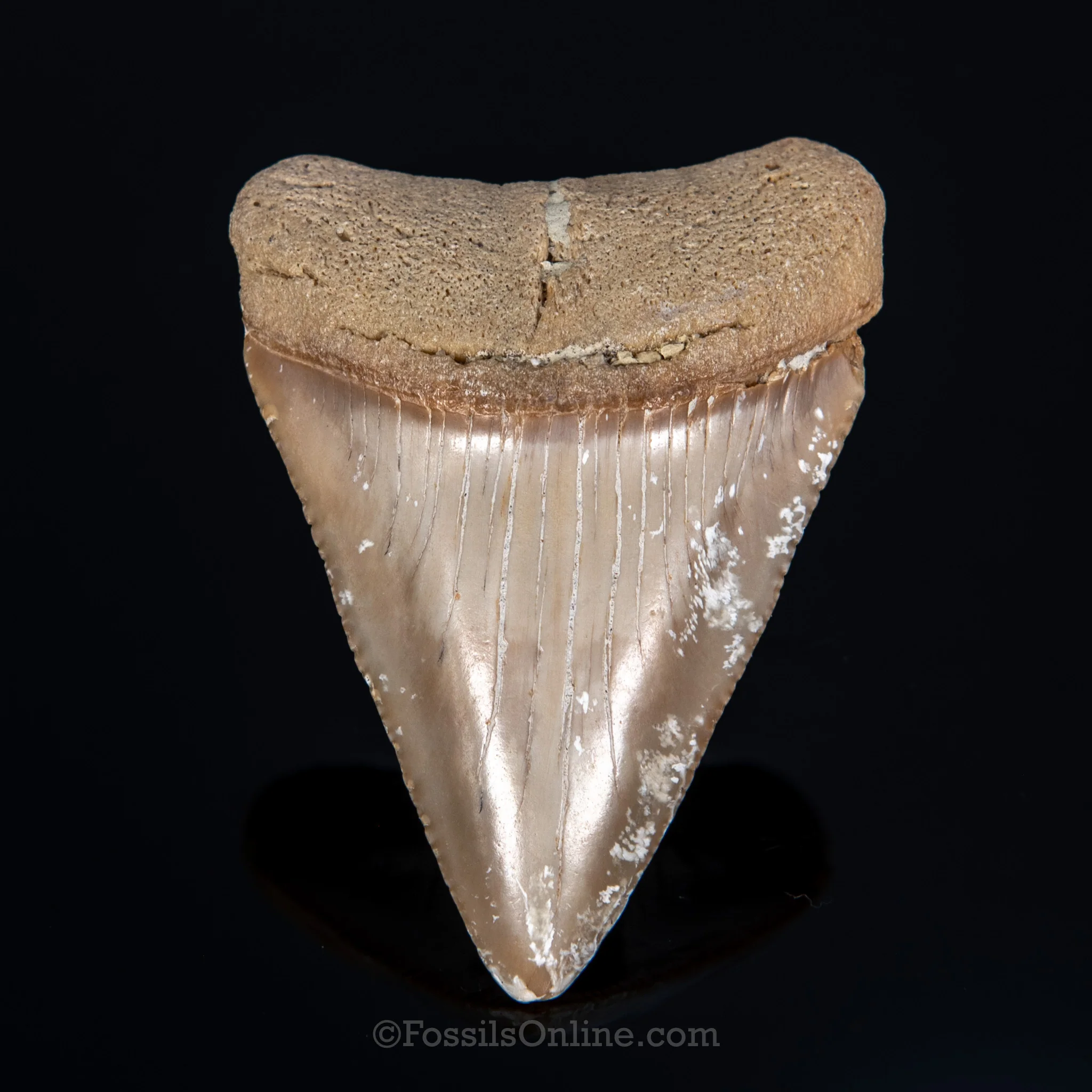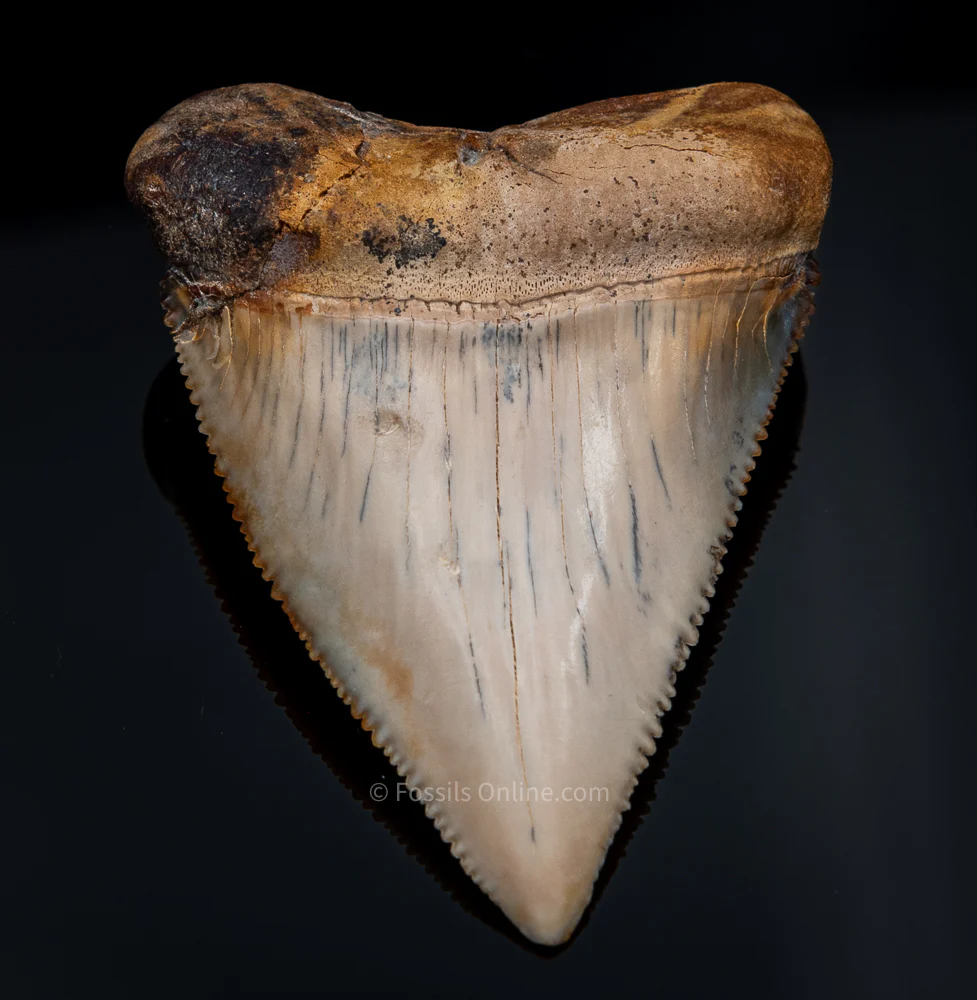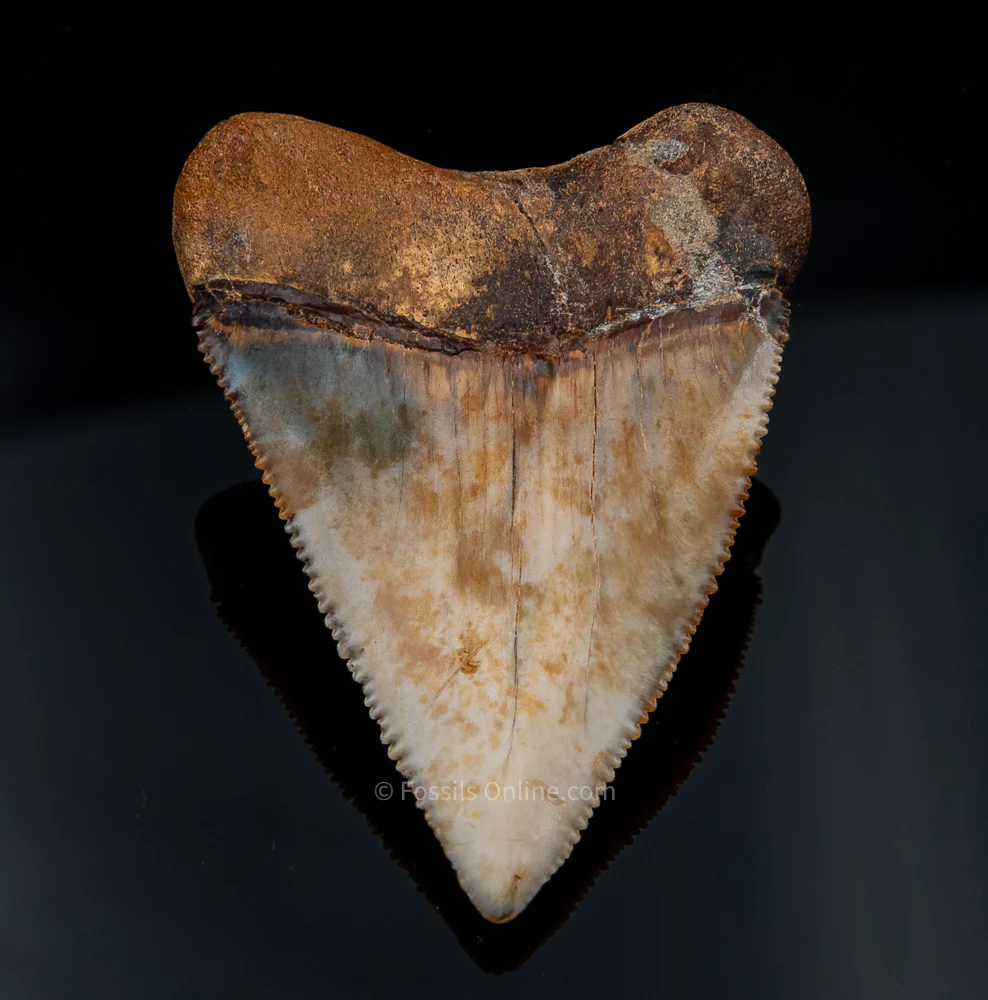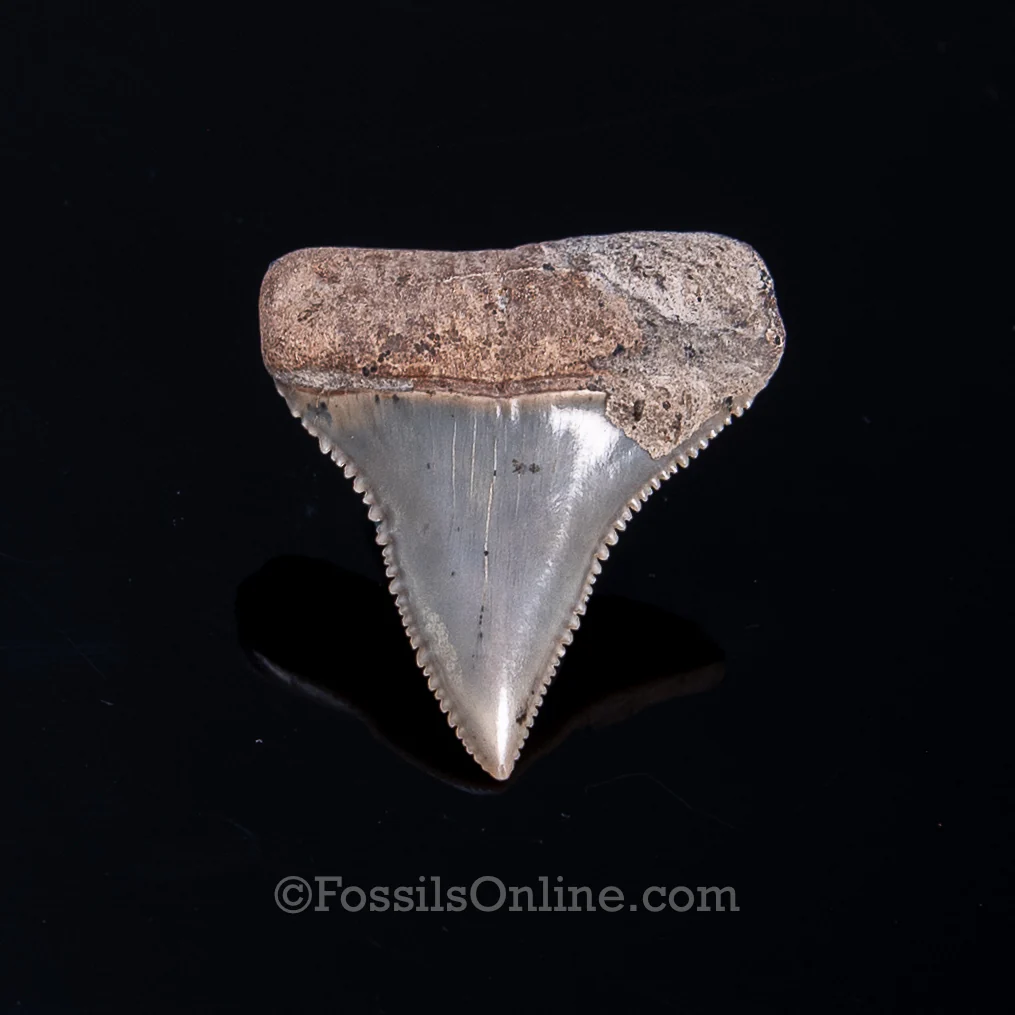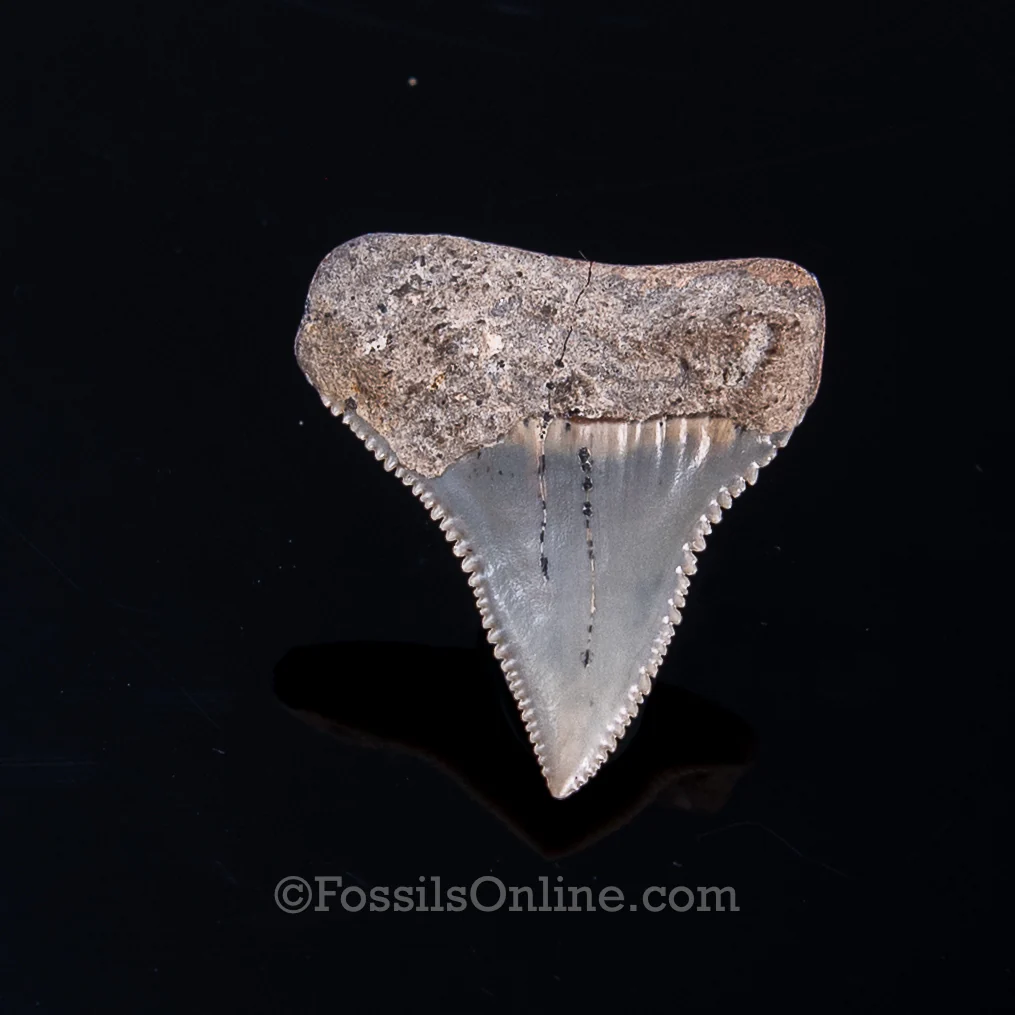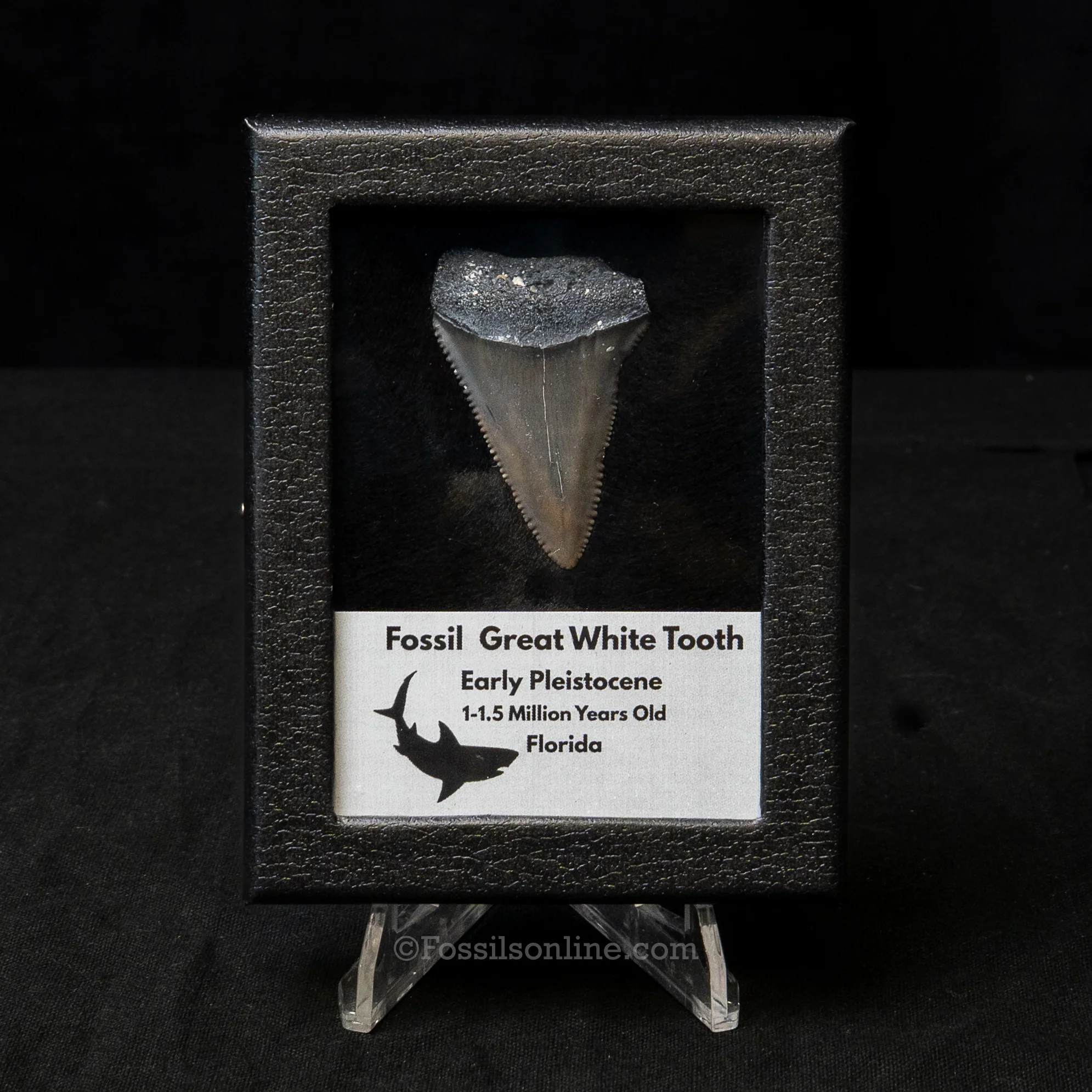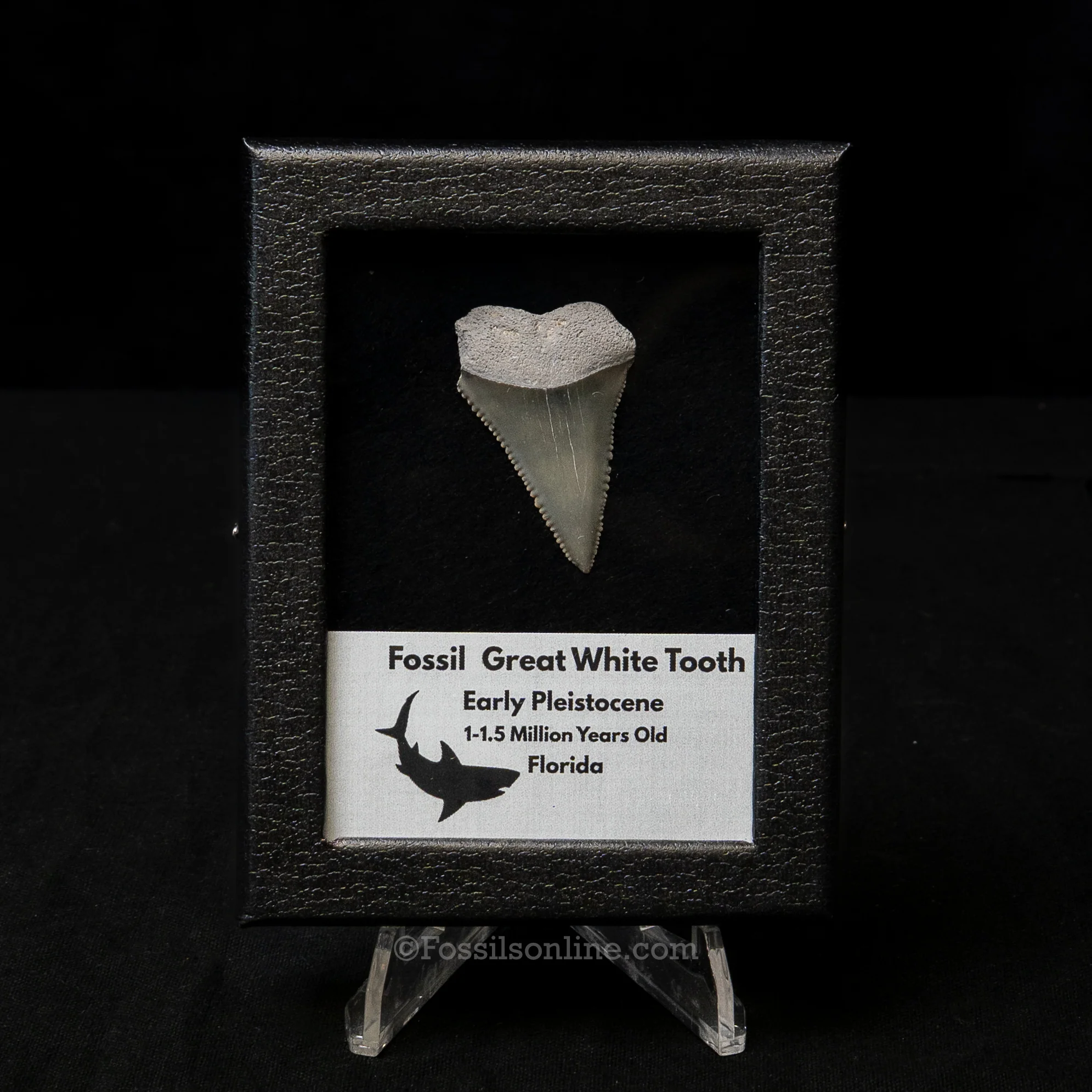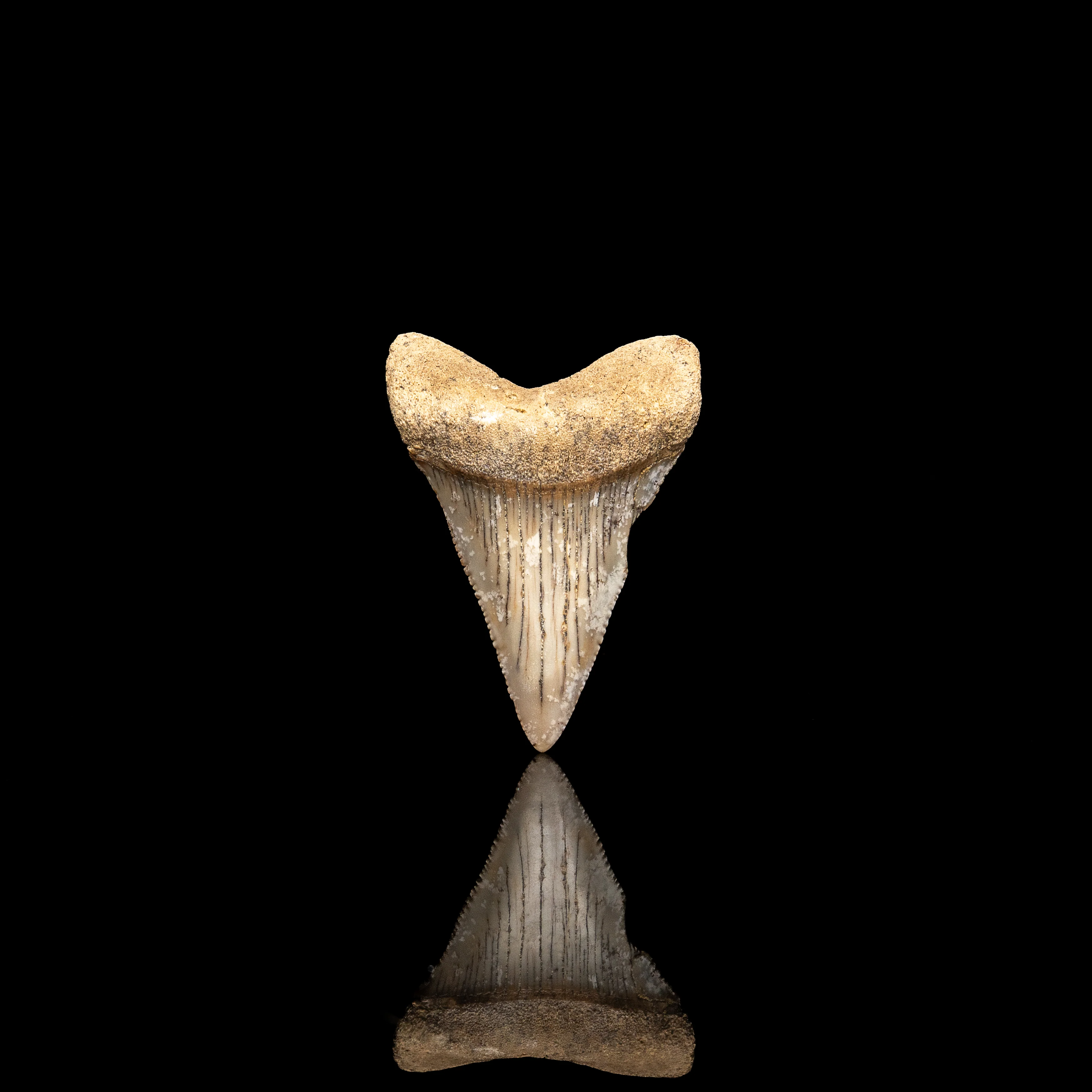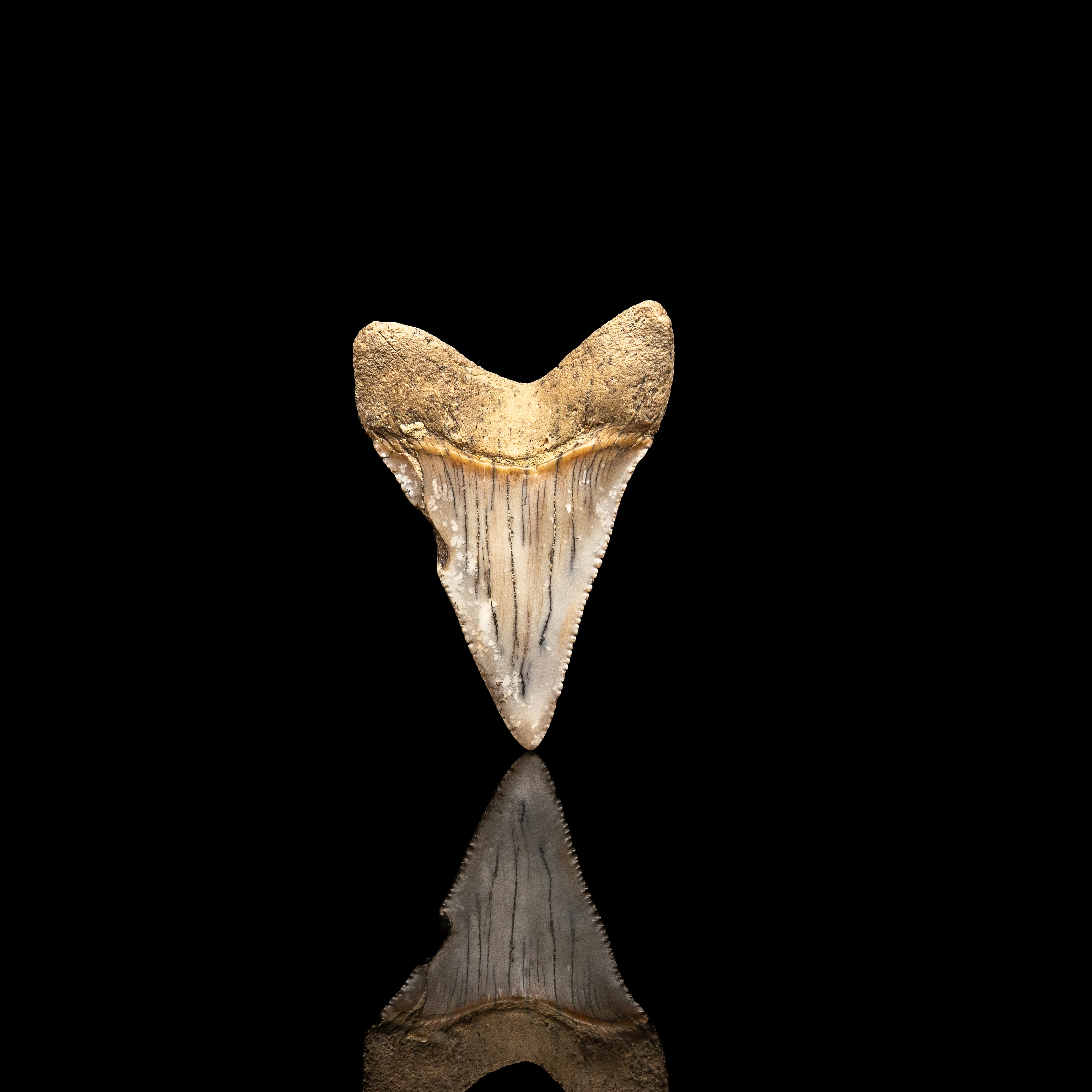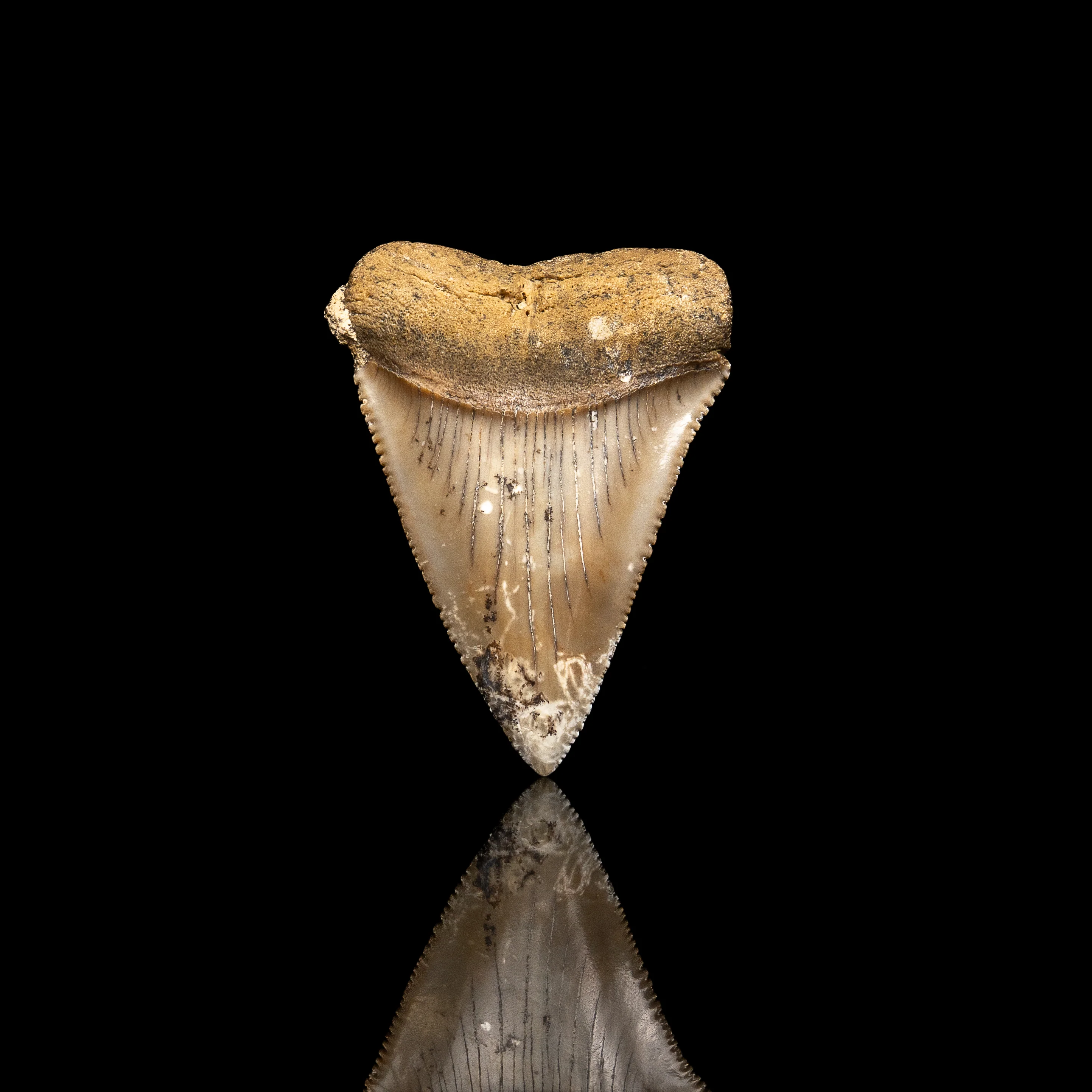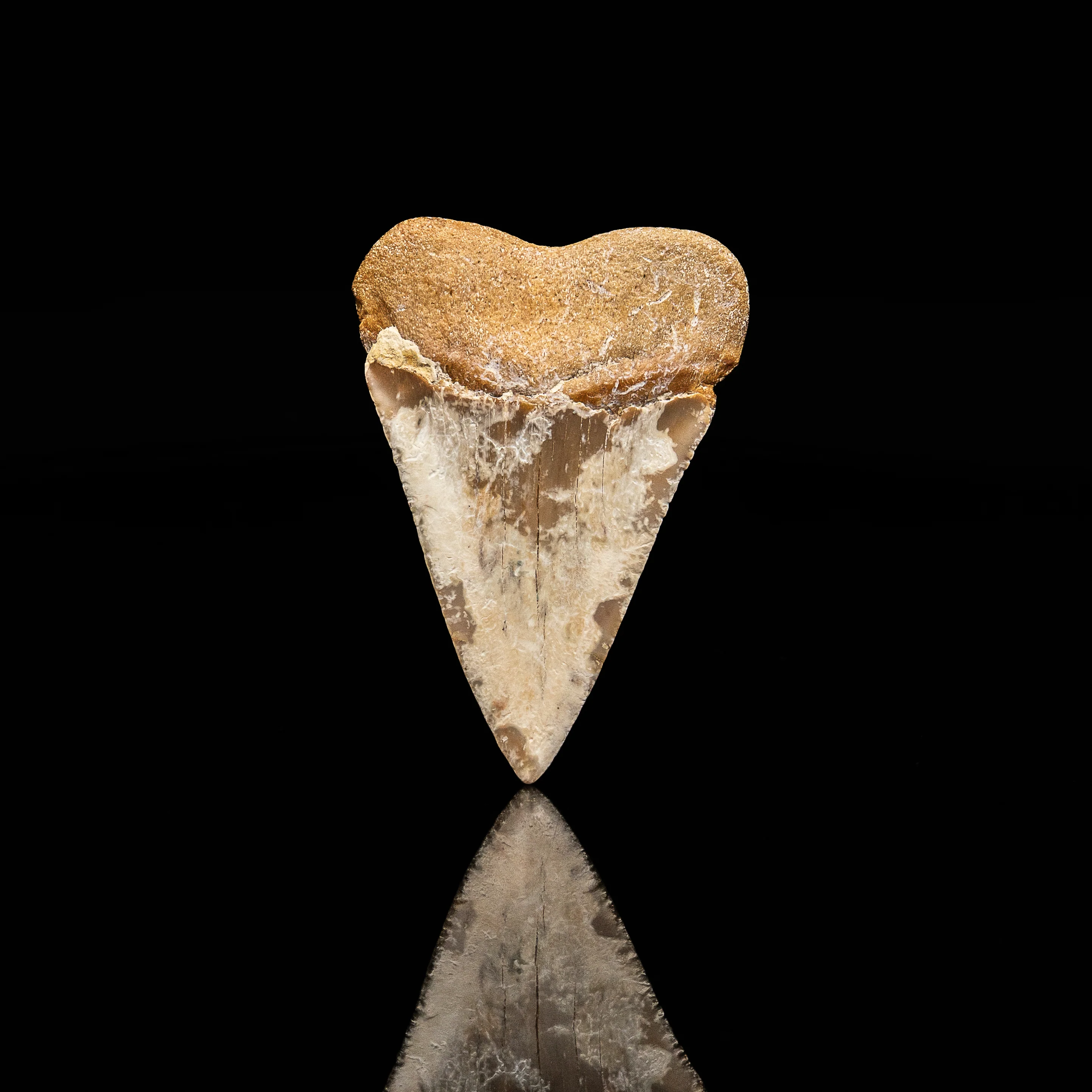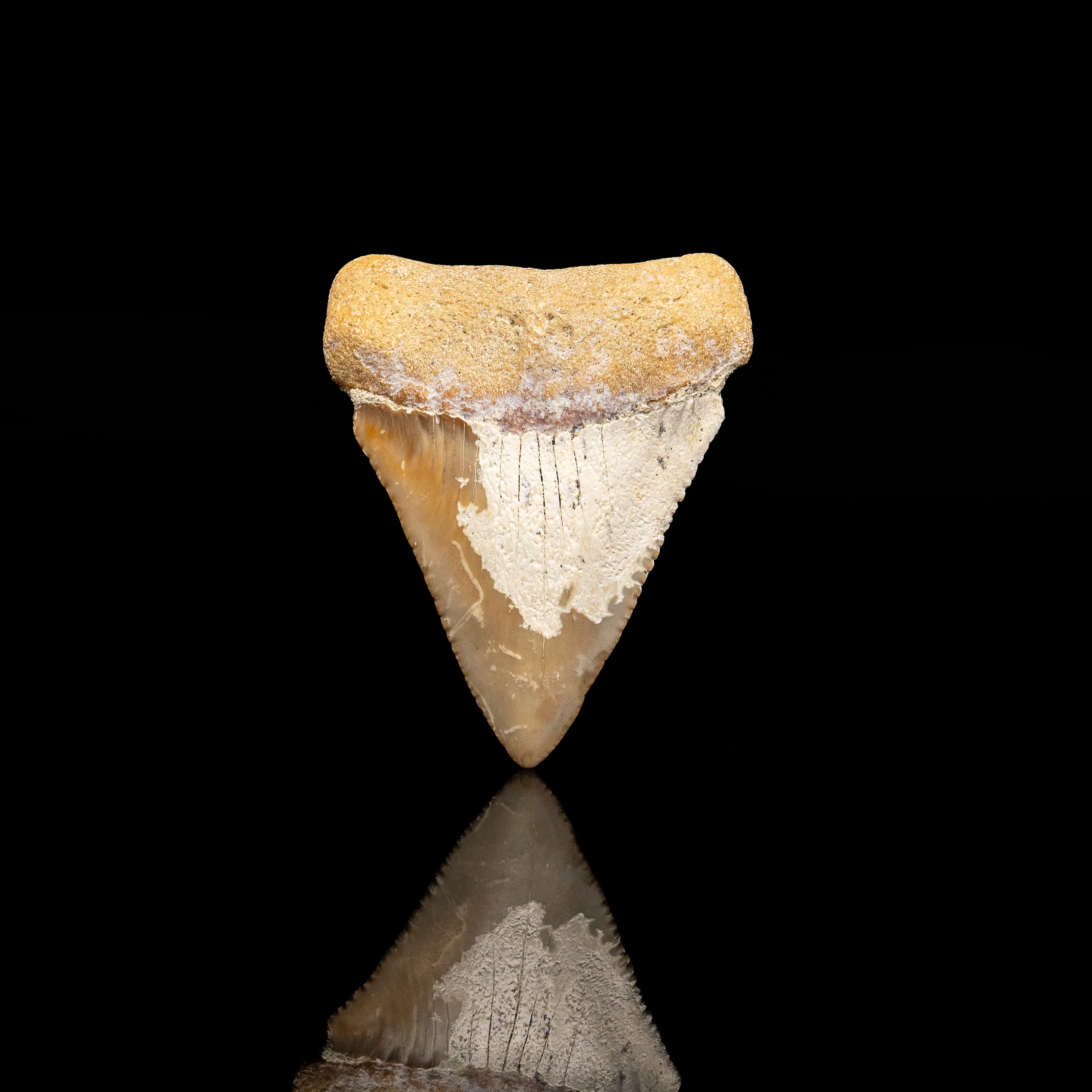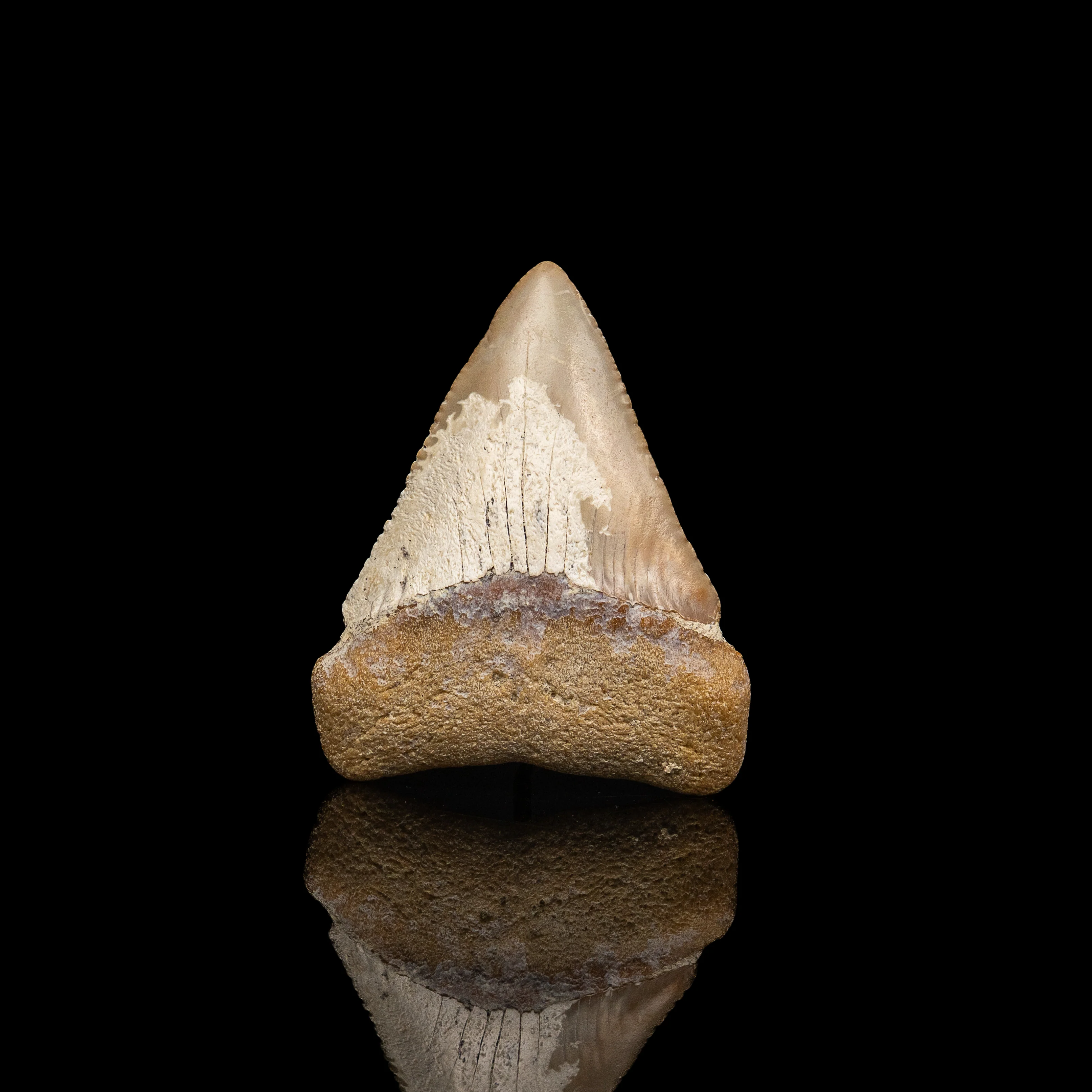
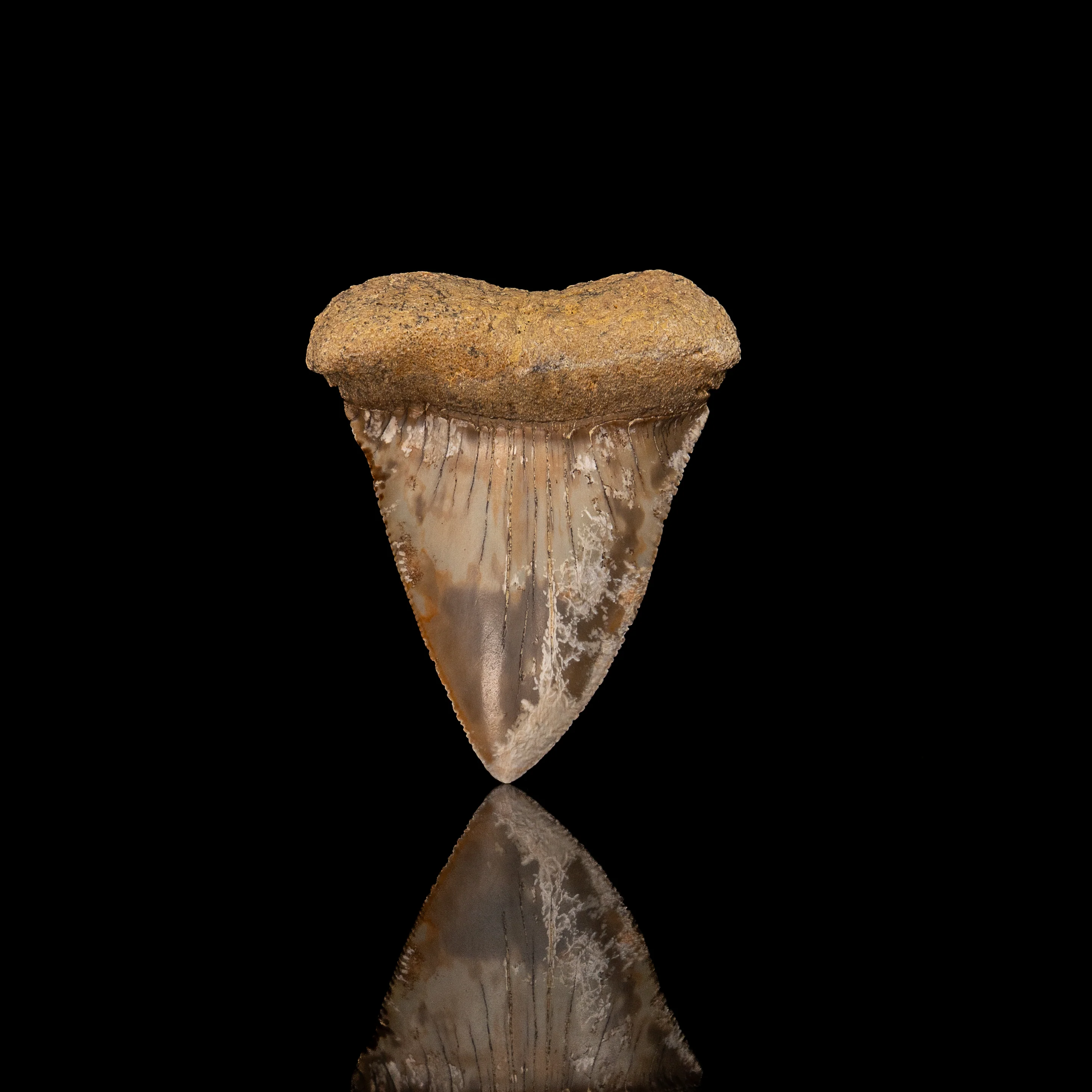
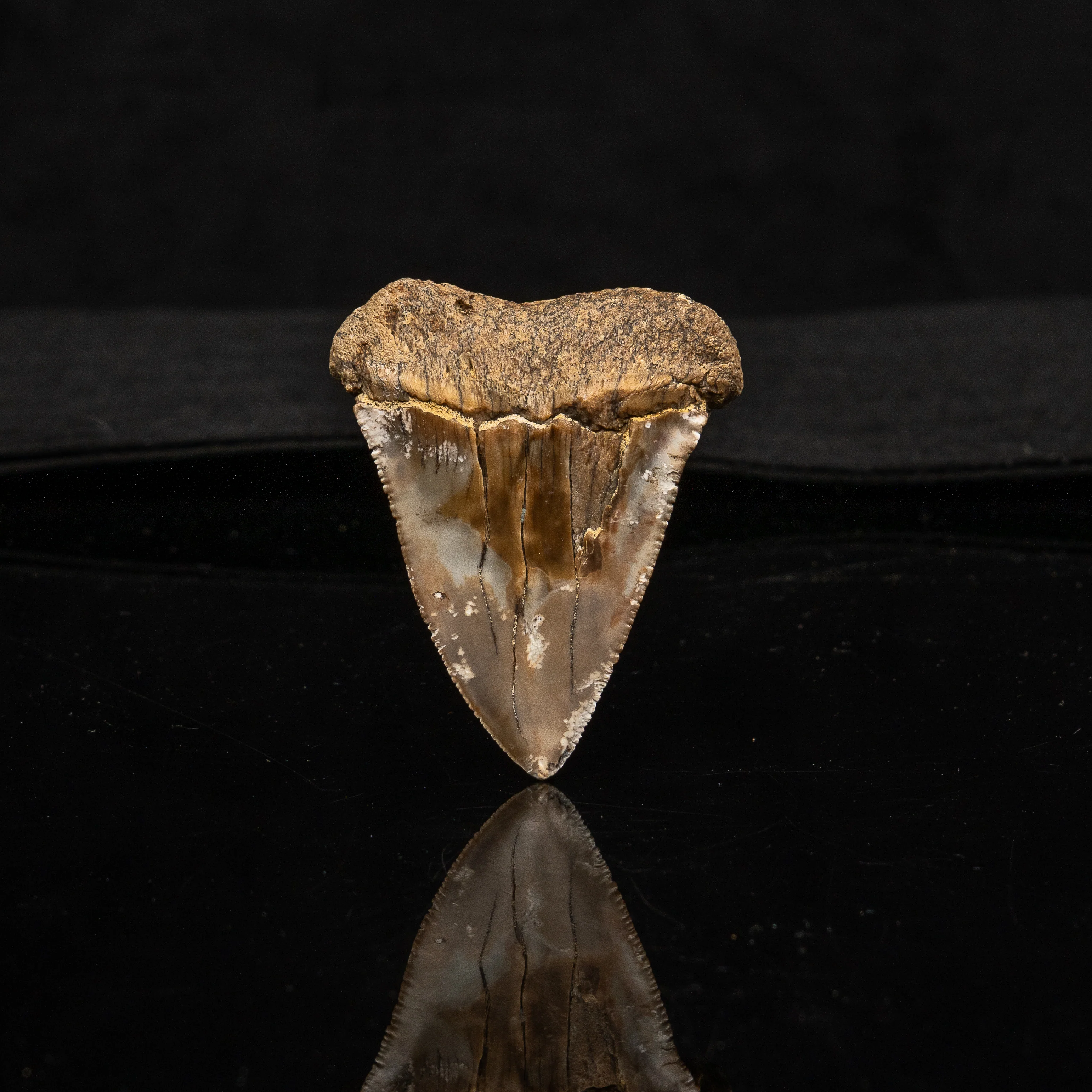
Fossil Great White 2.50" Baja California
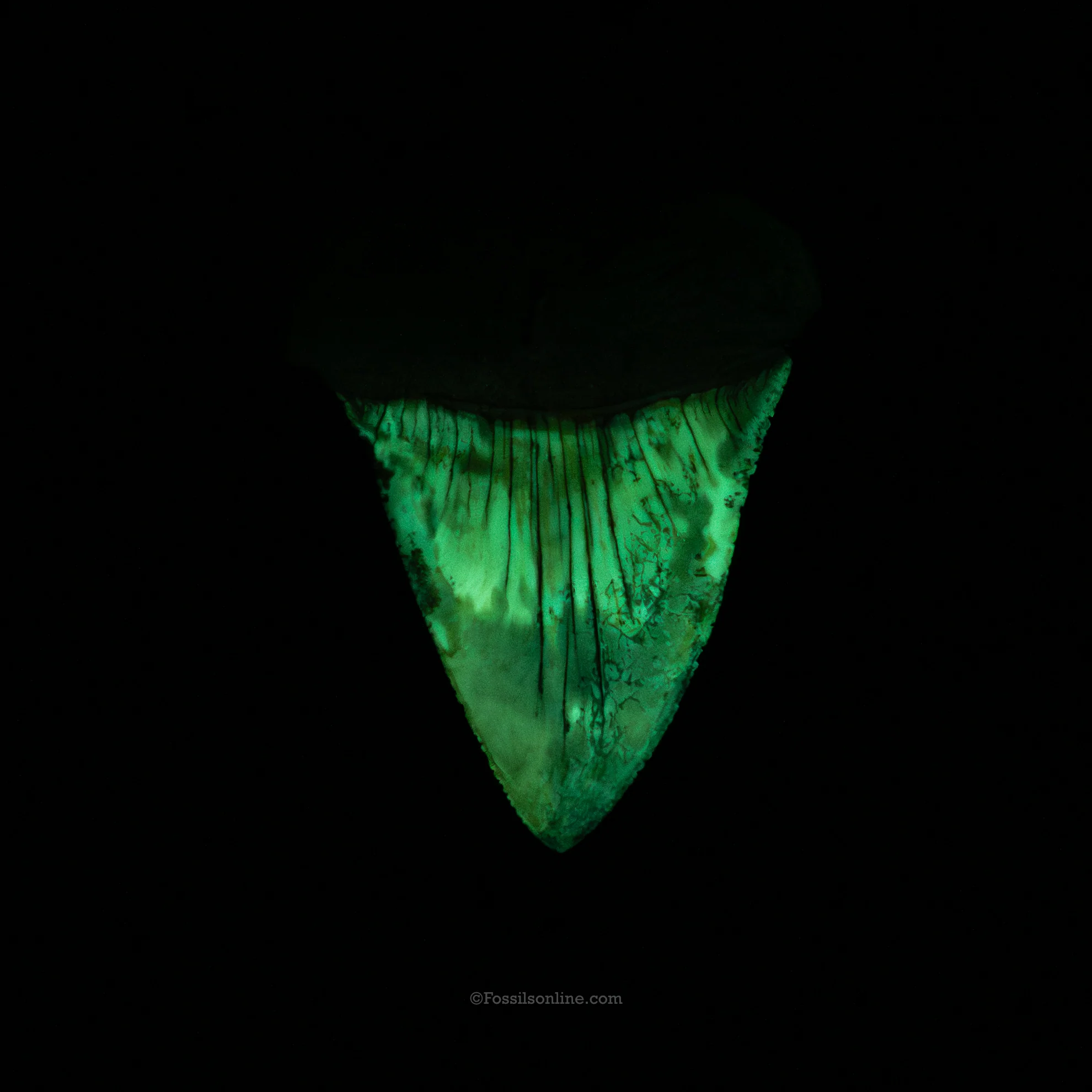
This beautiful Great White tooth has a beautiful coloration with an intact tip, and a very robust, dense root . It also phosphoresces under UV light due to high concentrations of phosphatic minerals and trace elements, which absorb UV energy and re-release it as visible light.
No repair or restoration
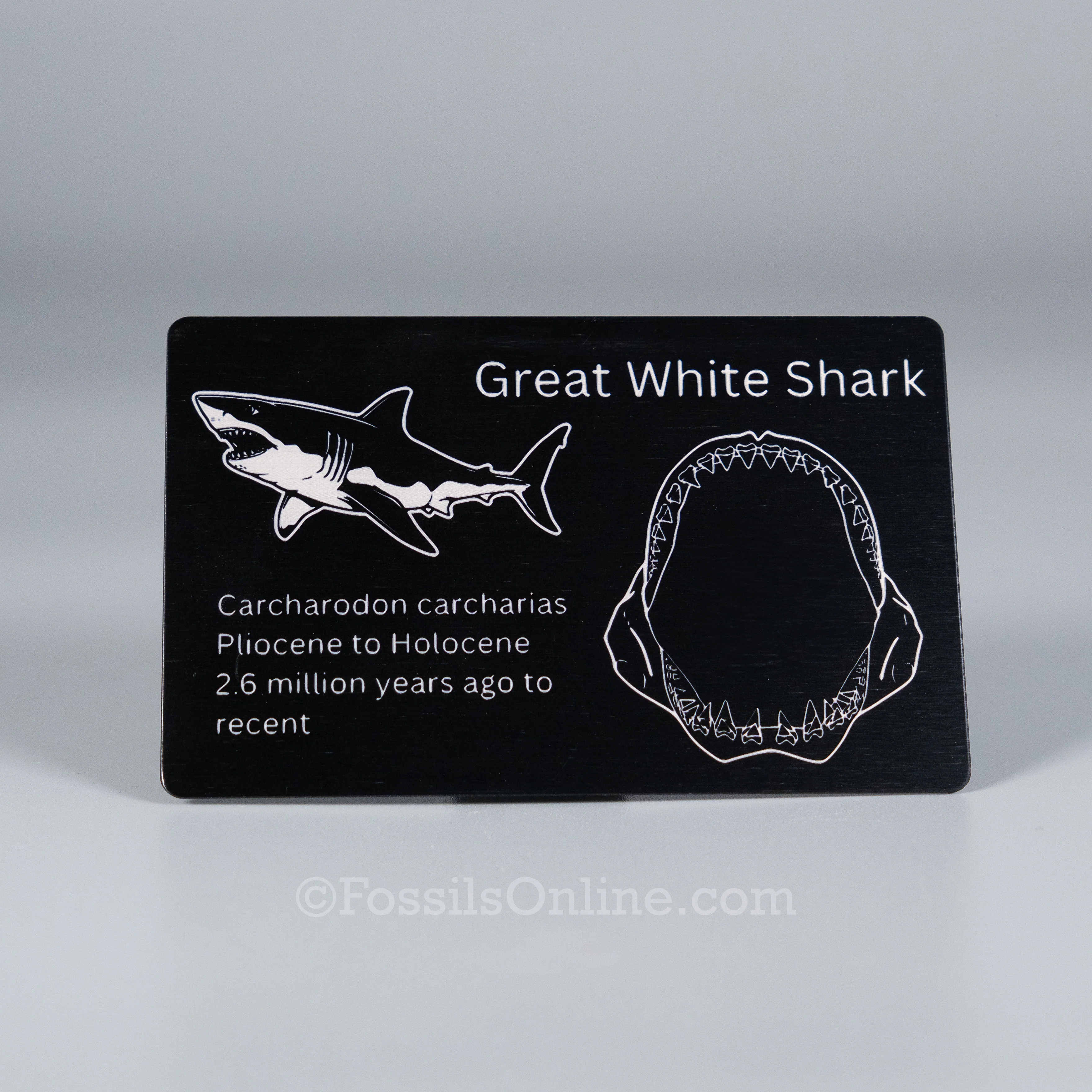
Great White Shark
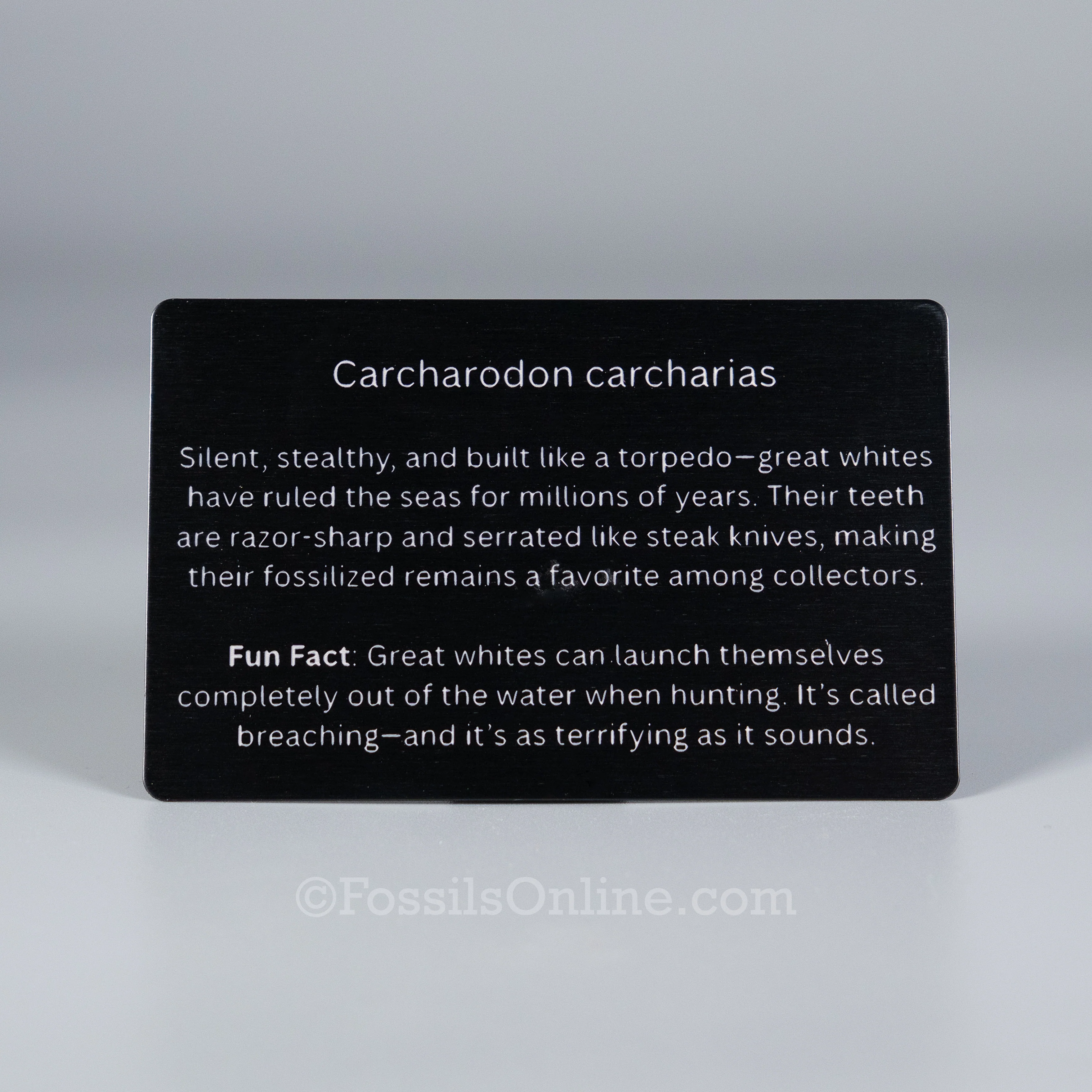
The great white shark is one of the most iconic marine predators alive today, but its story extends far beyond modern oceans. With a fossil record rooted in deep time and a body plan refined for efficiency, Carcharodon carcharias represents both evolutionary success and continuity—bridging ancient shark lineages with today’s apex predators.
When They Appeared in the Fossil Record
The earliest widely accepted fossils of true great white sharks appear during the late Miocene to early Pliocene, roughly 6 to 5 million years ago. These early specimens already display the defining features of the modern species, including broad triangular teeth with fine serrations adapted for cutting flesh.
There has been ongoing scientific debate about their ancestry. Earlier theories proposed a direct evolutionary link from the giant megatooth shark Otodus megalodon. However, current consensus places great whites closer to the mako shark lineage (Isurus), suggesting a separate evolutionary path that converged on a similar ecological role. Transitional fossils show a gradual shift from narrow, smooth-edged teeth (mako-like) to the wider, serrated cutting teeth characteristic of great whites.
Peak of Their Reign
Great whites rose to ecological prominence during the Pliocene Epoch (5.3–2.6 million years ago). During this time, global oceans supported abundant marine mammals, including early seals, sea lions, and small whales—ideal prey for a large, fast, serration-toothed predator.
With the decline and eventual extinction of larger apex sharks like Otodus megalodon around 3.6 million years ago, great whites likely expanded their ecological dominance. While not reaching the massive size of megalodon, they occupied a similar predatory niche in coastal and offshore environments.
Fossils from this period often show larger average tooth sizes than many modern populations, suggesting robust individuals thriving in nutrient-rich marine ecosystems.
Survival in the Modern Day
Unlike many prehistoric marine predators, great whites have persisted into the present with relatively little anatomical change. Today, they inhabit temperate and subtropical oceans worldwide, demonstrating remarkable adaptability.
Their continued survival can be attributed to:
-
A highly efficient body design optimized for speed and energy conservation
-
Regional endothermy (the ability to maintain body temperatures above ambient water)
-
A broad diet and flexible hunting strategies
However, modern populations face increasing pressures from human activity, including overfishing, bycatch, and habitat disruption. Despite this, they remain one of the ocean’s most effective apex predators.
Diet and Habitat
Great white sharks are opportunistic carnivores, with diet shifting as they mature:
Juveniles:
-
Primarily consume fish, rays, and smaller sharks
-
Tend to inhabit coastal nursery areas
Adults:
-
Target marine mammals such as seals, sea lions, and occasionally dolphins
-
Also scavenge whale carcasses
-
Capable of taking large prey due to powerful bite force and cutting dentition
Their preferred habitats include:
-
Coastal shelf waters
-
Areas with high marine mammal populations
-
Seasonal migratory routes between feeding and breeding grounds
They are known for long-distance migrations, sometimes crossing entire ocean basins.
Tooth Morphology
The teeth of Carcharodon carcharias are among the most specialized cutting tools in the animal kingdom:
-
Shape: Broad, triangular crowns
-
Edges: Fine, uniform serrations designed for slicing through flesh and blubber
-
Function: Teeth are adapted for cutting rather than crushing
-
Replacement: Like all sharks, they continuously replace teeth throughout life
The serrations act much like a saw, allowing efficient removal of large chunks of tissue. This adaptation is particularly effective for hunting marine mammals with thick layers of fat.
Fossil great white teeth are commonly found due to the durability of enamel and dentine, and they often retain excellent detail even after millions of years.
Similarities to Extinct Relatives
Great whites share several traits with extinct lamniform sharks, especially the megatooth lineage:
-
Serrated cutting teeth suited for large prey
-
Apex predator ecological role
-
Streamlined, torpedo-shaped bodies for speed
However, there are key differences:
-
Great white teeth are generally thinner and more finely serrated than those of Otodus megalodon
-
They lack the massive size and extreme bite force of their extinct counterpart
-
Evolutionary evidence suggests convergent evolution, not direct descent
They also retain similarities to mako sharks, including aspects of jaw structure and overall body design, reinforcing their likely evolutionary origin.
Growth, Size, and Life History
Modern great whites typically reach lengths of:
-
11–16 feet (3.5–5 meters) on average
-
Larger individuals exceeding 18 feet have been documented
They are slow-growing and long-lived, with estimates suggesting lifespans of 30–70+ years. Reproduction is ovoviviparous, meaning embryos develop inside eggs within the mother’s body and are born live.
Low reproductive rates make populations particularly vulnerable to decline.
Global Distribution and Migration
Great white sharks have a cosmopolitan distribution, found in:
-
The Pacific (California, Baja California, Australia)
-
The Atlantic (South Africa, northeastern U.S.)
-
The Indian Ocean
They are known for:
-
Seasonal migrations tied to prey availability
-
Deep-water excursions and offshore movements
-
Returning to specific feeding sites annually
These patterns highlight their complex behavioral ecology and reliance on stable marine ecosystems.
Enduring Legacy
The great white shark stands as a rare example of a predator that has successfully navigated millions of years of environmental change. From its emergence in the late Miocene to its dominance in today’s oceans, it represents both evolutionary refinement and resilience. Whether encountered as a living animal or preserved as a fossil tooth, Carcharodon carcharias offers a direct connection to the dynamic and often dramatic history of life in Earth’s oceans.
Product Information
Product Information
Shipping & Returns
Shipping & Returns
Fossil Great White 2.50" Baja California
Fossil Great White 2.50" Baja California
This beautiful Great White tooth has a beautiful coloration with an intact tip, and a very robust, dense root . It also phosphoresces under UV light due to high concentrations of phosphatic minerals and trace elements, which absorb UV energy and re-release it as visible light.
No repair or restoration
Great White Shark
The great white shark is one of the most iconic marine predators alive today, but its story extends far beyond modern oceans. With a fossil record rooted in deep time and a body plan refined for efficiency, Carcharodon carcharias represents both evolutionary success and continuity—bridging ancient shark lineages with today’s apex predators.
When They Appeared in the Fossil Record
The earliest widely accepted fossils of true great white sharks appear during the late Miocene to early Pliocene, roughly 6 to 5 million years ago. These early specimens already display the defining features of the modern species, including broad triangular teeth with fine serrations adapted for cutting flesh.
There has been ongoing scientific debate about their ancestry. Earlier theories proposed a direct evolutionary link from the giant megatooth shark Otodus megalodon. However, current consensus places great whites closer to the mako shark lineage (Isurus), suggesting a separate evolutionary path that converged on a similar ecological role. Transitional fossils show a gradual shift from narrow, smooth-edged teeth (mako-like) to the wider, serrated cutting teeth characteristic of great whites.
Peak of Their Reign
Great whites rose to ecological prominence during the Pliocene Epoch (5.3–2.6 million years ago). During this time, global oceans supported abundant marine mammals, including early seals, sea lions, and small whales—ideal prey for a large, fast, serration-toothed predator.
With the decline and eventual extinction of larger apex sharks like Otodus megalodon around 3.6 million years ago, great whites likely expanded their ecological dominance. While not reaching the massive size of megalodon, they occupied a similar predatory niche in coastal and offshore environments.
Fossils from this period often show larger average tooth sizes than many modern populations, suggesting robust individuals thriving in nutrient-rich marine ecosystems.
Survival in the Modern Day
Unlike many prehistoric marine predators, great whites have persisted into the present with relatively little anatomical change. Today, they inhabit temperate and subtropical oceans worldwide, demonstrating remarkable adaptability.
Their continued survival can be attributed to:
-
A highly efficient body design optimized for speed and energy conservation
-
Regional endothermy (the ability to maintain body temperatures above ambient water)
-
A broad diet and flexible hunting strategies
However, modern populations face increasing pressures from human activity, including overfishing, bycatch, and habitat disruption. Despite this, they remain one of the ocean’s most effective apex predators.
Diet and Habitat
Great white sharks are opportunistic carnivores, with diet shifting as they mature:
Juveniles:
-
Primarily consume fish, rays, and smaller sharks
-
Tend to inhabit coastal nursery areas
Adults:
-
Target marine mammals such as seals, sea lions, and occasionally dolphins
-
Also scavenge whale carcasses
-
Capable of taking large prey due to powerful bite force and cutting dentition
Their preferred habitats include:
-
Coastal shelf waters
-
Areas with high marine mammal populations
-
Seasonal migratory routes between feeding and breeding grounds
They are known for long-distance migrations, sometimes crossing entire ocean basins.
Tooth Morphology
The teeth of Carcharodon carcharias are among the most specialized cutting tools in the animal kingdom:
-
Shape: Broad, triangular crowns
-
Edges: Fine, uniform serrations designed for slicing through flesh and blubber
-
Function: Teeth are adapted for cutting rather than crushing
-
Replacement: Like all sharks, they continuously replace teeth throughout life
The serrations act much like a saw, allowing efficient removal of large chunks of tissue. This adaptation is particularly effective for hunting marine mammals with thick layers of fat.
Fossil great white teeth are commonly found due to the durability of enamel and dentine, and they often retain excellent detail even after millions of years.
Similarities to Extinct Relatives
Great whites share several traits with extinct lamniform sharks, especially the megatooth lineage:
-
Serrated cutting teeth suited for large prey
-
Apex predator ecological role
-
Streamlined, torpedo-shaped bodies for speed
However, there are key differences:
-
Great white teeth are generally thinner and more finely serrated than those of Otodus megalodon
-
They lack the massive size and extreme bite force of their extinct counterpart
-
Evolutionary evidence suggests convergent evolution, not direct descent
They also retain similarities to mako sharks, including aspects of jaw structure and overall body design, reinforcing their likely evolutionary origin.
Growth, Size, and Life History
Modern great whites typically reach lengths of:
-
11–16 feet (3.5–5 meters) on average
-
Larger individuals exceeding 18 feet have been documented
They are slow-growing and long-lived, with estimates suggesting lifespans of 30–70+ years. Reproduction is ovoviviparous, meaning embryos develop inside eggs within the mother’s body and are born live.
Low reproductive rates make populations particularly vulnerable to decline.
Global Distribution and Migration
Great white sharks have a cosmopolitan distribution, found in:
-
The Pacific (California, Baja California, Australia)
-
The Atlantic (South Africa, northeastern U.S.)
-
The Indian Ocean
They are known for:
-
Seasonal migrations tied to prey availability
-
Deep-water excursions and offshore movements
-
Returning to specific feeding sites annually
These patterns highlight their complex behavioral ecology and reliance on stable marine ecosystems.
Enduring Legacy
The great white shark stands as a rare example of a predator that has successfully navigated millions of years of environmental change. From its emergence in the late Miocene to its dominance in today’s oceans, it represents both evolutionary refinement and resilience. Whether encountered as a living animal or preserved as a fossil tooth, Carcharodon carcharias offers a direct connection to the dynamic and often dramatic history of life in Earth’s oceans.
Original: $349.00
-65%$349.00
$122.15Product Information
Product Information
Shipping & Returns
Shipping & Returns
Description
This beautiful Great White tooth has a beautiful coloration with an intact tip, and a very robust, dense root . It also phosphoresces under UV light due to high concentrations of phosphatic minerals and trace elements, which absorb UV energy and re-release it as visible light.
No repair or restoration
Great White Shark
The great white shark is one of the most iconic marine predators alive today, but its story extends far beyond modern oceans. With a fossil record rooted in deep time and a body plan refined for efficiency, Carcharodon carcharias represents both evolutionary success and continuity—bridging ancient shark lineages with today’s apex predators.
When They Appeared in the Fossil Record
The earliest widely accepted fossils of true great white sharks appear during the late Miocene to early Pliocene, roughly 6 to 5 million years ago. These early specimens already display the defining features of the modern species, including broad triangular teeth with fine serrations adapted for cutting flesh.
There has been ongoing scientific debate about their ancestry. Earlier theories proposed a direct evolutionary link from the giant megatooth shark Otodus megalodon. However, current consensus places great whites closer to the mako shark lineage (Isurus), suggesting a separate evolutionary path that converged on a similar ecological role. Transitional fossils show a gradual shift from narrow, smooth-edged teeth (mako-like) to the wider, serrated cutting teeth characteristic of great whites.
Peak of Their Reign
Great whites rose to ecological prominence during the Pliocene Epoch (5.3–2.6 million years ago). During this time, global oceans supported abundant marine mammals, including early seals, sea lions, and small whales—ideal prey for a large, fast, serration-toothed predator.
With the decline and eventual extinction of larger apex sharks like Otodus megalodon around 3.6 million years ago, great whites likely expanded their ecological dominance. While not reaching the massive size of megalodon, they occupied a similar predatory niche in coastal and offshore environments.
Fossils from this period often show larger average tooth sizes than many modern populations, suggesting robust individuals thriving in nutrient-rich marine ecosystems.
Survival in the Modern Day
Unlike many prehistoric marine predators, great whites have persisted into the present with relatively little anatomical change. Today, they inhabit temperate and subtropical oceans worldwide, demonstrating remarkable adaptability.
Their continued survival can be attributed to:
-
A highly efficient body design optimized for speed and energy conservation
-
Regional endothermy (the ability to maintain body temperatures above ambient water)
-
A broad diet and flexible hunting strategies
However, modern populations face increasing pressures from human activity, including overfishing, bycatch, and habitat disruption. Despite this, they remain one of the ocean’s most effective apex predators.
Diet and Habitat
Great white sharks are opportunistic carnivores, with diet shifting as they mature:
Juveniles:
-
Primarily consume fish, rays, and smaller sharks
-
Tend to inhabit coastal nursery areas
Adults:
-
Target marine mammals such as seals, sea lions, and occasionally dolphins
-
Also scavenge whale carcasses
-
Capable of taking large prey due to powerful bite force and cutting dentition
Their preferred habitats include:
-
Coastal shelf waters
-
Areas with high marine mammal populations
-
Seasonal migratory routes between feeding and breeding grounds
They are known for long-distance migrations, sometimes crossing entire ocean basins.
Tooth Morphology
The teeth of Carcharodon carcharias are among the most specialized cutting tools in the animal kingdom:
-
Shape: Broad, triangular crowns
-
Edges: Fine, uniform serrations designed for slicing through flesh and blubber
-
Function: Teeth are adapted for cutting rather than crushing
-
Replacement: Like all sharks, they continuously replace teeth throughout life
The serrations act much like a saw, allowing efficient removal of large chunks of tissue. This adaptation is particularly effective for hunting marine mammals with thick layers of fat.
Fossil great white teeth are commonly found due to the durability of enamel and dentine, and they often retain excellent detail even after millions of years.
Similarities to Extinct Relatives
Great whites share several traits with extinct lamniform sharks, especially the megatooth lineage:
-
Serrated cutting teeth suited for large prey
-
Apex predator ecological role
-
Streamlined, torpedo-shaped bodies for speed
However, there are key differences:
-
Great white teeth are generally thinner and more finely serrated than those of Otodus megalodon
-
They lack the massive size and extreme bite force of their extinct counterpart
-
Evolutionary evidence suggests convergent evolution, not direct descent
They also retain similarities to mako sharks, including aspects of jaw structure and overall body design, reinforcing their likely evolutionary origin.
Growth, Size, and Life History
Modern great whites typically reach lengths of:
-
11–16 feet (3.5–5 meters) on average
-
Larger individuals exceeding 18 feet have been documented
They are slow-growing and long-lived, with estimates suggesting lifespans of 30–70+ years. Reproduction is ovoviviparous, meaning embryos develop inside eggs within the mother’s body and are born live.
Low reproductive rates make populations particularly vulnerable to decline.
Global Distribution and Migration
Great white sharks have a cosmopolitan distribution, found in:
-
The Pacific (California, Baja California, Australia)
-
The Atlantic (South Africa, northeastern U.S.)
-
The Indian Ocean
They are known for:
-
Seasonal migrations tied to prey availability
-
Deep-water excursions and offshore movements
-
Returning to specific feeding sites annually
These patterns highlight their complex behavioral ecology and reliance on stable marine ecosystems.
Enduring Legacy
The great white shark stands as a rare example of a predator that has successfully navigated millions of years of environmental change. From its emergence in the late Miocene to its dominance in today’s oceans, it represents both evolutionary refinement and resilience. Whether encountered as a living animal or preserved as a fossil tooth, Carcharodon carcharias offers a direct connection to the dynamic and often dramatic history of life in Earth’s oceans.